25 Black Bathroom Decor Ideas for a Bold, Elegant Look
I used to think a black bathroom would feel like stepping into a cave, and I put the idea off for years. Then I painted one wall in our guest bathroom the deepest charcoal I could find, stood back, and realised the room had not shrunk at all — it had gained a spine. Black, done well, is not gloomy. It is the colour that makes brass glow, marble look expensive and a white towel look freshly laundered. In this post I am sharing the twenty-five ideas I have tried, borrowed and refined along the way, from one brave feature wall to the small finishing touches that keep the whole room feeling warm. Take what suits your space, and leave the rest.
1. Start With a Matte Black Feature Wall
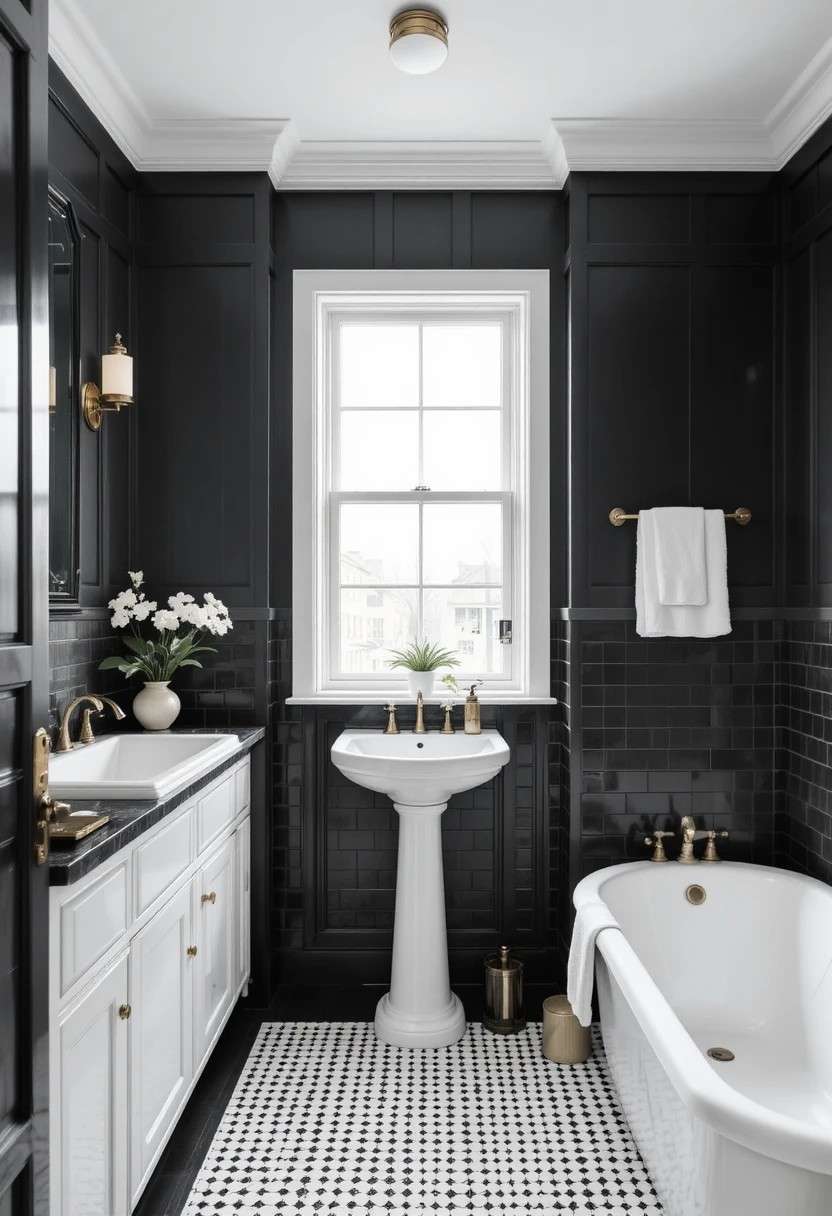
I will be honest: the first time I rolled matte black paint onto a bathroom wall, my hand hovered over the roller for ten seconds. It felt like a dare. But matte black is the kindest way to go bold, because it drinks the light instead of throwing it back at you, and the room feels tailored rather than painted. Our black wall sits behind the bath, and against it the white basin and a brass tap look deliberate. The trick is picking the right wall — the one you see first — and letting the other three stay pale, so the black reads as a choice, not a takeover.
How to do it: Pick the wall opposite the door or behind the bath, then clean it, fill any dents and apply a stain-blocking primer. Paint two coats of matte bathroom paint in a soft black, such as charcoal or off-black, cutting in carefully at the ceiling. Leave the other walls pale, hang one pale-framed picture or a mirror on the black wall, and live with it for a week before deciding whether to add more black.
2. Pair Black With Warm Wood
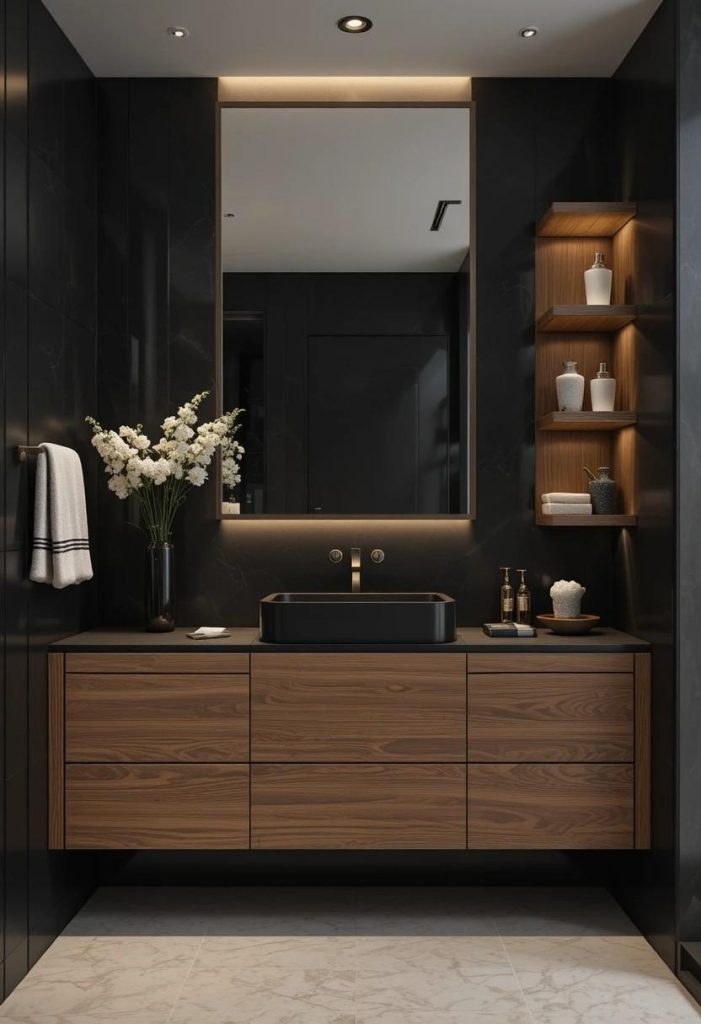
Black on its own can feel a little severe, and wood is the material that talks it down. I first tried it with a second-hand oak stool beside the bath, and the room changed overnight — suddenly the black tiles looked intentional instead of stark, and the whole space felt like somewhere you could linger. Warm timber does something no paint can: it brings grain, knots and a faint honey colour that softens every hard edge. I now use one wood tone only, a mid oak, and repeat it in small doses so the room feels collected rather than decorated.
How to do it: Choose one warm wood, such as oak, walnut or teak, and use it in two or three places: a stool, a bath tray and a towel ladder. Keep the wood oiled or sealed so steam does not stain it, and avoid mixing pale pine with dark walnut in the same room. Let the black stay the bold note and the wood the warm one.
3. Add Brass or Gold Fixtures
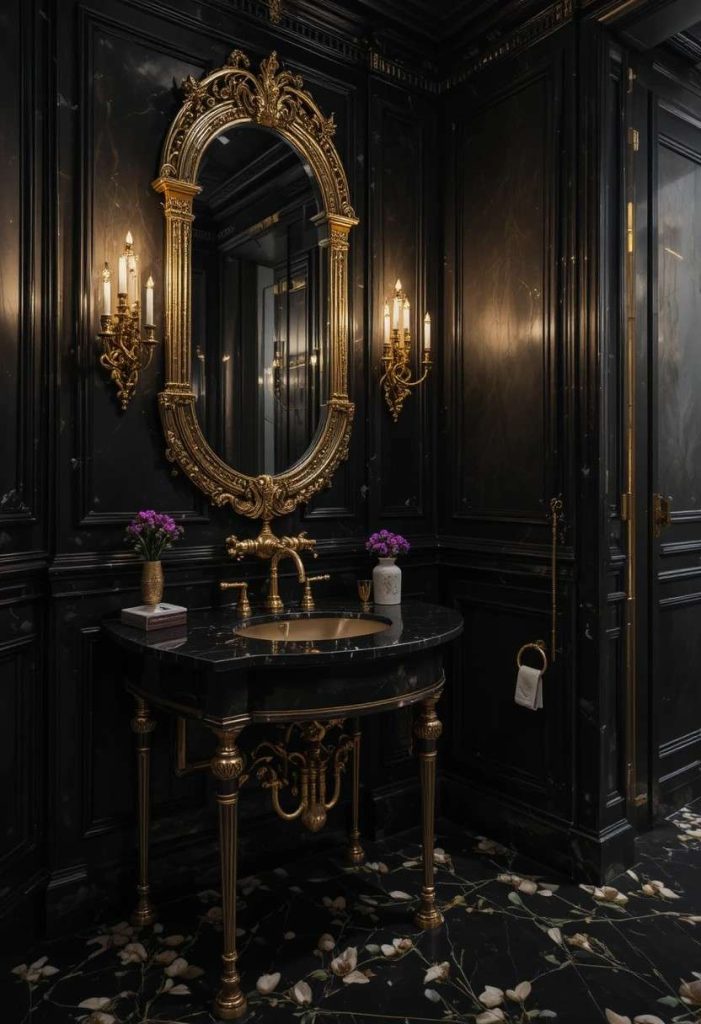
There is a moment, usually late in the afternoon, when the sun hits our brass taps and the whole black bathroom glows. I chose unlacquered brass because I wanted the metal to age with us — it has already picked up a soft patina around the handles, and I love it more for that. Gold and brass do for black what candlelight does for a dining room: they warm it, lift it and stop it feeling flat. One word of caution from my own wallet: buy the taps, shower and handles in the same finish, because two nearly-matching golds side by side will bother you every single day.
How to do it: Order finish samples first and hold them against your tiles in daylight and lamplight. Fit the same brass or gold finish on taps, shower fittings, cabinet handles and the mirror frame. Wipe unlacquered brass dry after use, and clean it with a soft cloth and mild soap only — never an abrasive cream.
4. Use Black and White Together
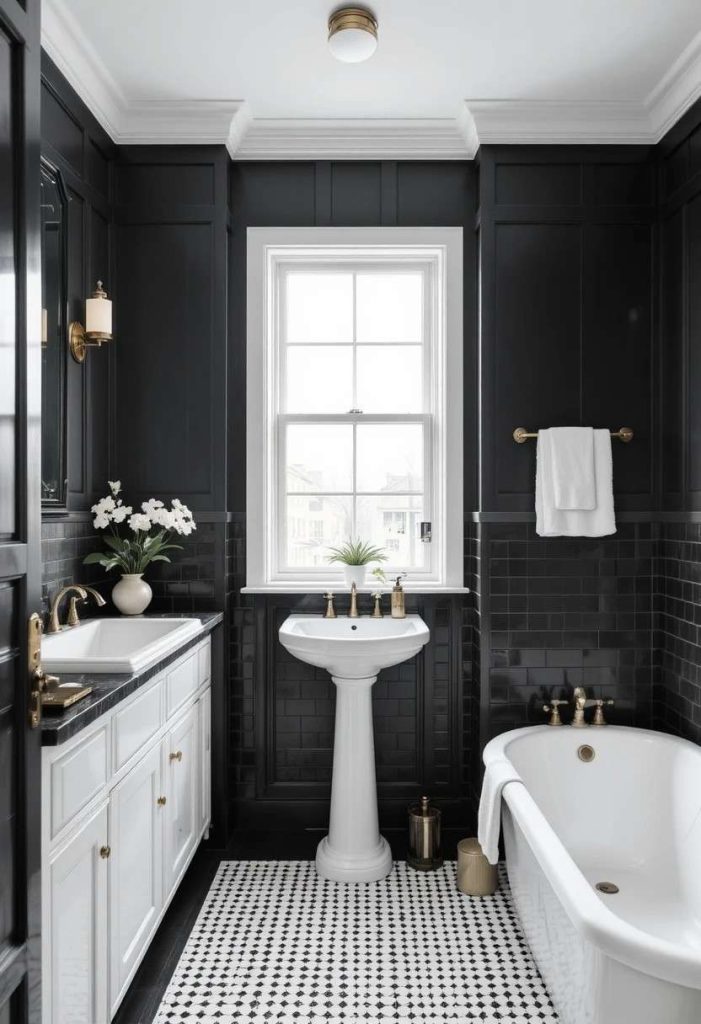
If black feels like a leap, black and white together is the gentlest way in — and, in my opinion, the hardest to get wrong. Our guest bathroom pairs a black vanity and black-framed mirror with white walls and a white floor, and guests always assume it cost far more than it did. The trick is the ratio: I keep roughly two-thirds pale and one-third black, so the dark reads as punctuation rather than the whole sentence. Crisp white towels, a white bath mat and a pale ceiling do the heavy lifting, and the black simply makes them look cleaner.
How to do it: Start with white walls, ceiling and sanitaryware, then add black in three places: the vanity, the mirror frame and one accessory, such as a soap dispenser. Keep the black to about a third of what you see, and repeat it — a single black object on its own looks like a mistake. Step back and check the balance from the doorway.
5. Add Plenty of Soft Lighting
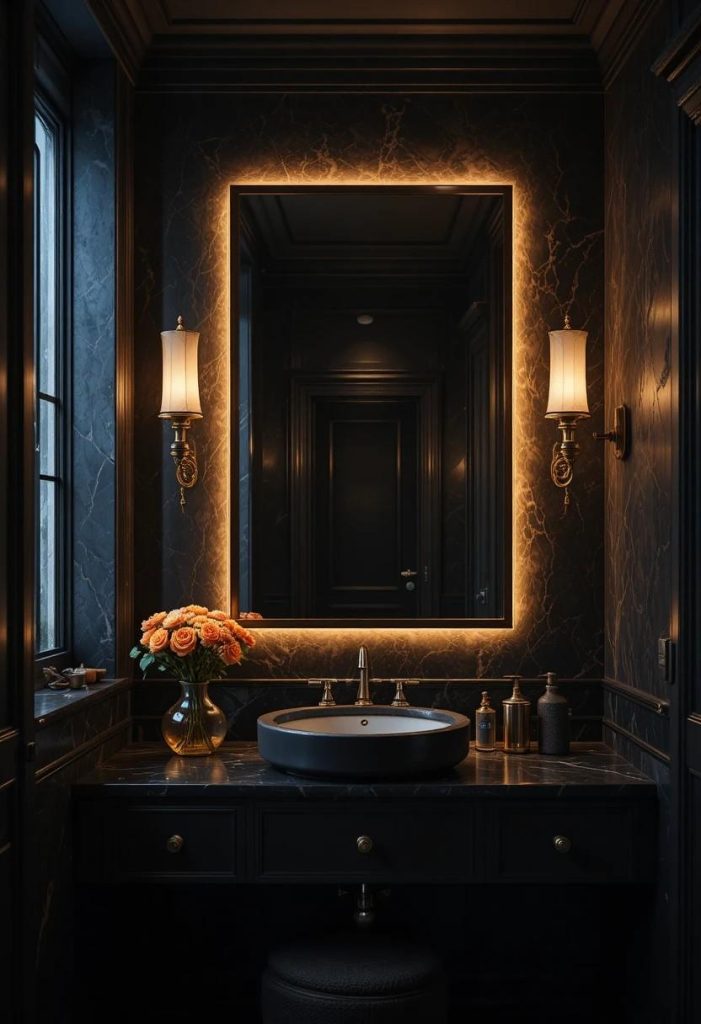
Lighting is the difference between a black bathroom that feels like a boutique hotel and one that feels like a cupboard, and I learned that the expensive way when our first attempt relied on a single ceiling bulb. Now we have sconces beside the mirror, a dimmer on the ceiling light and a small low glow for evenings, and the black walls drink it all in beautifully. I planned the layers using these bathroom lighting ideas, because getting the brightness right matters twice as much when the walls are dark. Warm light is non-negotiable for me — cool white against black makes everyone look tired.
How to do it: Fit sconces at eye level on either side of the mirror, about 150 to 165 centimetres from the floor, and put the ceiling light on a dimmer. Choose warm 2700K LED bulbs throughout, and add one low light, such as an under-vanity strip, for night-time visits. Have all wiring done by a qualified electrician.
6. Try Black Hexagon Tiles
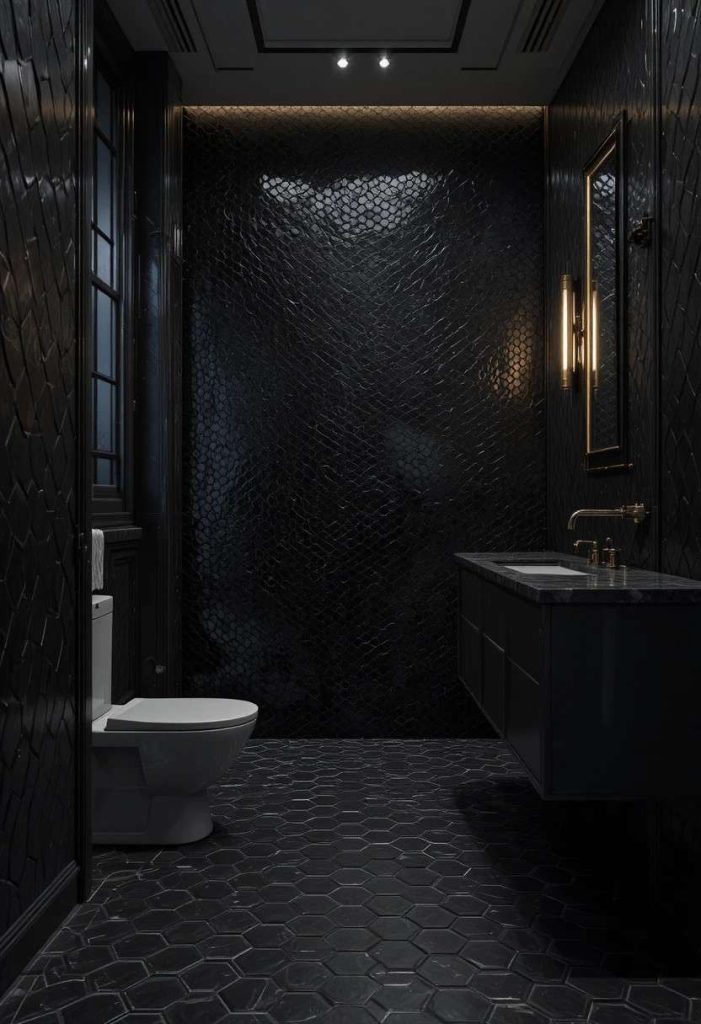
Hexagon tiles were my compromise when I wanted pattern without committing to a busy print. On our floor they read as quietly geometric from the doorway, and only when you stand on them do you notice how the shape breaks up the black and stops it feeling like one flat slab. I chose a matte finish with pale grout at first, then switched to dark grout after a month of staring at grubby grout lines — a small decision that saved me a weekly scrub. The shape is forgiving too: it suits a modern room and a cottage bathroom equally well, which is rare for anything black.
How to do it: Measure the floor, order tiles plus ten per cent extra for cuts, and dry-lay a section to check the pattern. Lay from the centre of the room outwards so cut tiles sit at the edges, and use a dark grout if you want the pattern subtle or a pale grout if you want it to pop. Seal the grout once it has cured.
7. Add Lush Greenery
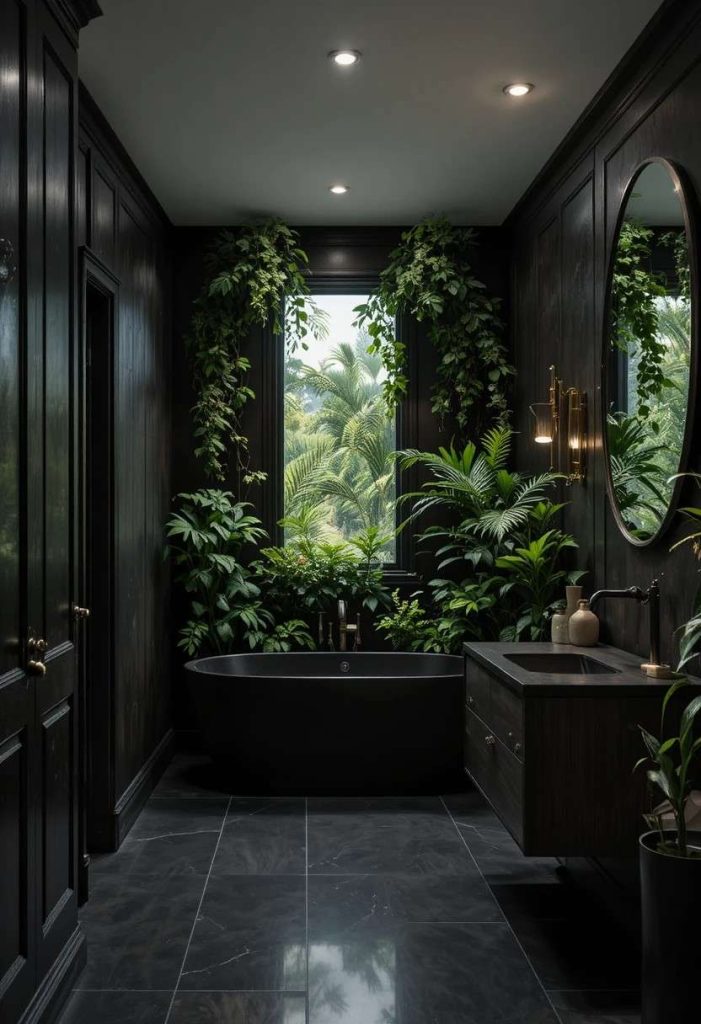
A plant in a black bathroom is the cheapest transformation I know. I keep a pothos trailing from a shelf above the bath, and its green leaves against the dark wall are the first thing I notice every morning — the room feels alive rather than decorated. Bathrooms suit plants more than people expect: the steam, the warmth and the humidity are exactly what pothos, ferns and peace lilies enjoy. If you want the green to go further than a plant or two, my sage green bathroom ideas lean into the same fresh, leafy feeling with paint and tiles, and they pair beautifully with black.
How to do it: Choose two or three humidity-loving plants, such as pothos, a small fern or a peace lily, and place them at different heights — a shelf, the windowsill and the floor. Use pots in cream, terracotta or rattan so they stand out against the black. Water sparingly, wipe the leaves monthly, and rotate the plants so they grow evenly.
8. Use a Matte Black Vanity
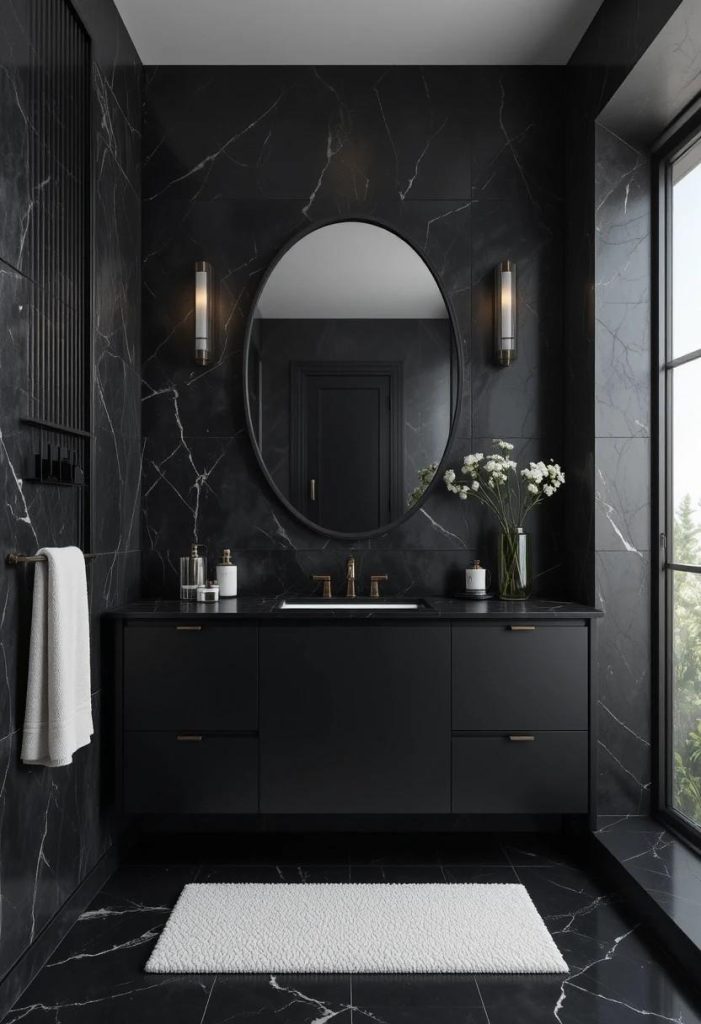
The vanity is the piece of furniture you touch a dozen times a day, so it was the first thing I changed in our bathroom — and the one I would change again first. A matte black vanity grounds the room the way a good rug grounds a living room: everything else arranges itself around it. I chose a floating one with slim legs, because seeing a little floor beneath it keeps the room feeling light, and the matte finish hides fingerprints far better than gloss ever did. Paired with a pale stone top and a round mirror, it looks considered rather than heavy, which is exactly the balance black needs.
How to do it: Measure the wall and leave at least 60 centimetres clear in front of the vanity for comfortable use. Choose a matte, moisture-resistant finish and a pale worktop, such as white quartz or marble-look stone, to keep the unit from looking like a block. Fit soft-close drawers, keep the countertop clear, and wipe the front down weekly with a damp cloth.
9. Add Marble Accents
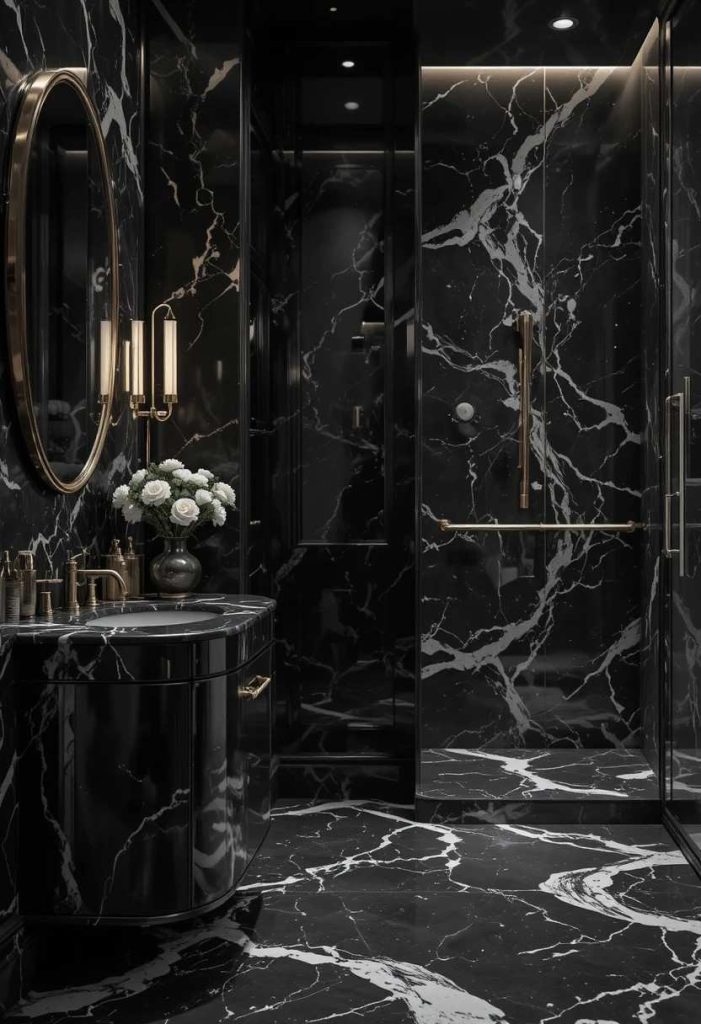
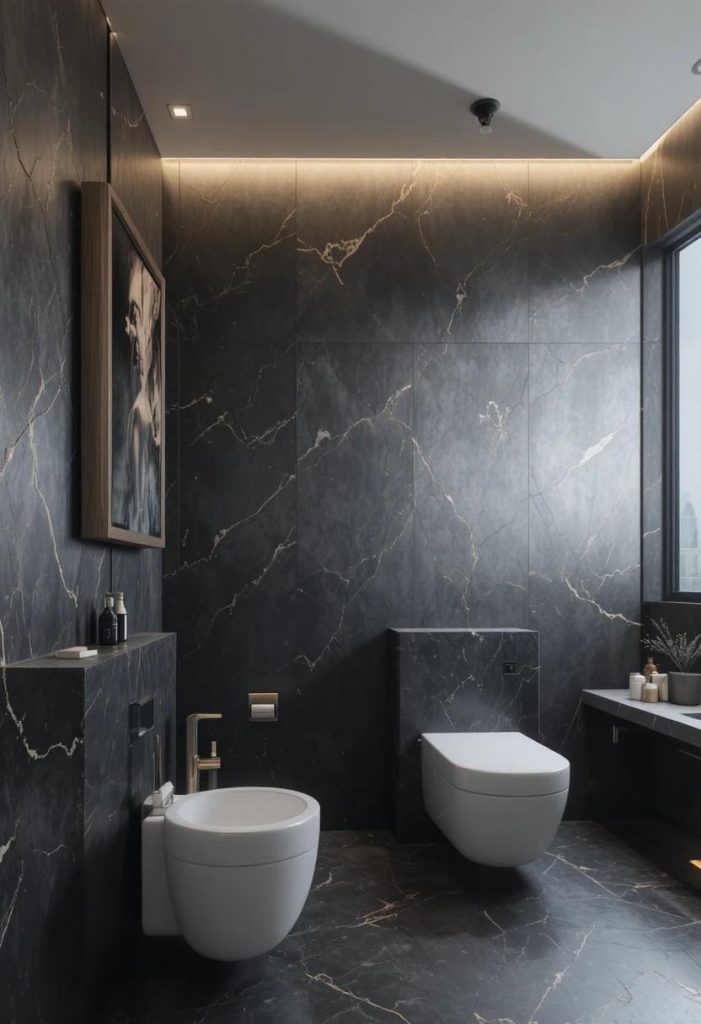
Marble is the material that makes black feel expensive rather than merely dark, and I have never regretted the veined marble shelf I fitted above our bath. The white veins catch the light and give your eye somewhere to rest, which matters in a room where most surfaces are the same deep tone. I kept our marble to two surfaces — the vanity top and one shelf — because a little reads as luxury and a lot reads as a showroom. If real marble stretches the budget, a good marble-look porcelain does the same job in a bathroom, and it shrugs off water spots that would mark the real stone.
How to do it: Choose marble, or a marble-look porcelain, for one or two surfaces only, such as the vanity top and a shelf. Seal real marble before use and reseal it once a year, since it stains easily. Pair it with matte black fittings and keep the veining soft grey rather than bold gold for a calm look.
10. Keep Some White Space
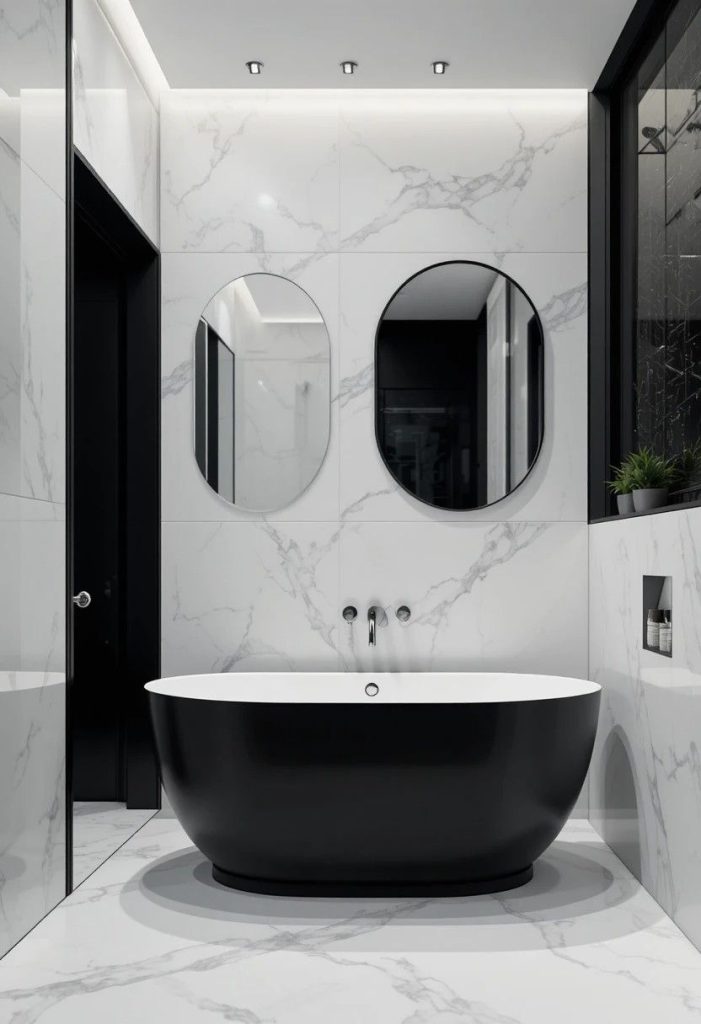
This is the idea I resisted longest, because when you fall for black you want it everywhere. But the white ceiling in our bathroom is the single best decision in the room — it lifts the whole space, bounces light down from the window, and stops the black walls from pressing in. I think of white space as breathing room: a pale ceiling, a white bath, a stretch of unpainted wall above the tiles. It does not dilute the drama at all; it frames it. Without those pale pauses, black stops being a statement and starts being a cave, and nobody relaxes in a cave.
How to do it: Keep the ceiling and the upper third of at least one wall white, and choose white sanitaryware. Leave a clear stretch of pale wall above the tiles, and use white or cream towels and a pale bath mat. Stand in the doorway and check that you can see pale surfaces from every angle.
11. Add a Statement Mirror
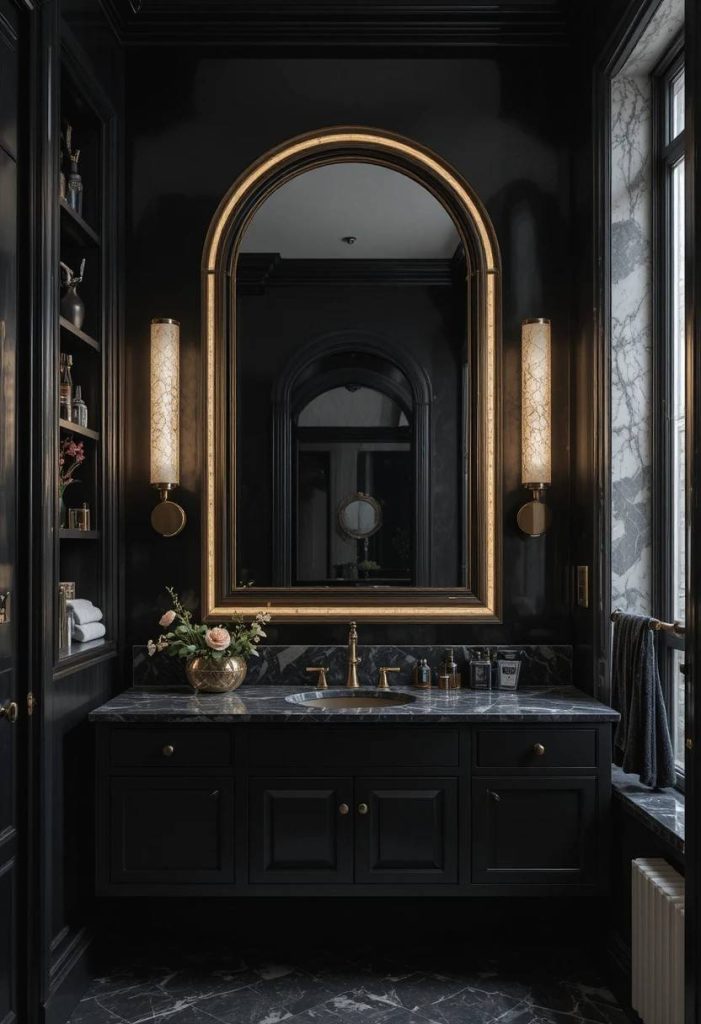
A mirror in a black bathroom does double duty: it is the prettiest thing on the wall and the hardest-working light source in the room. Ours is a large arched mirror with a thin black frame, and it throws daylight from the window right back across the dark tiles — on a sunny morning the whole room glows. I hung it slightly lower than I first planned, so the centre sits at eye level, and that one change made getting ready in the morning noticeably easier. Choose a shape with a curve if your room is full of straight black lines; the arch softens everything around it.
How to do it: Choose a mirror about two-thirds the width of your vanity, in a round or arched shape to soften straight black lines. Hang it so its centre sits at eye level, roughly 150 centimetres from the floor. If you can, place it opposite or beside a window so it reflects daylight into the room.
12. Use Textured Black Tiles
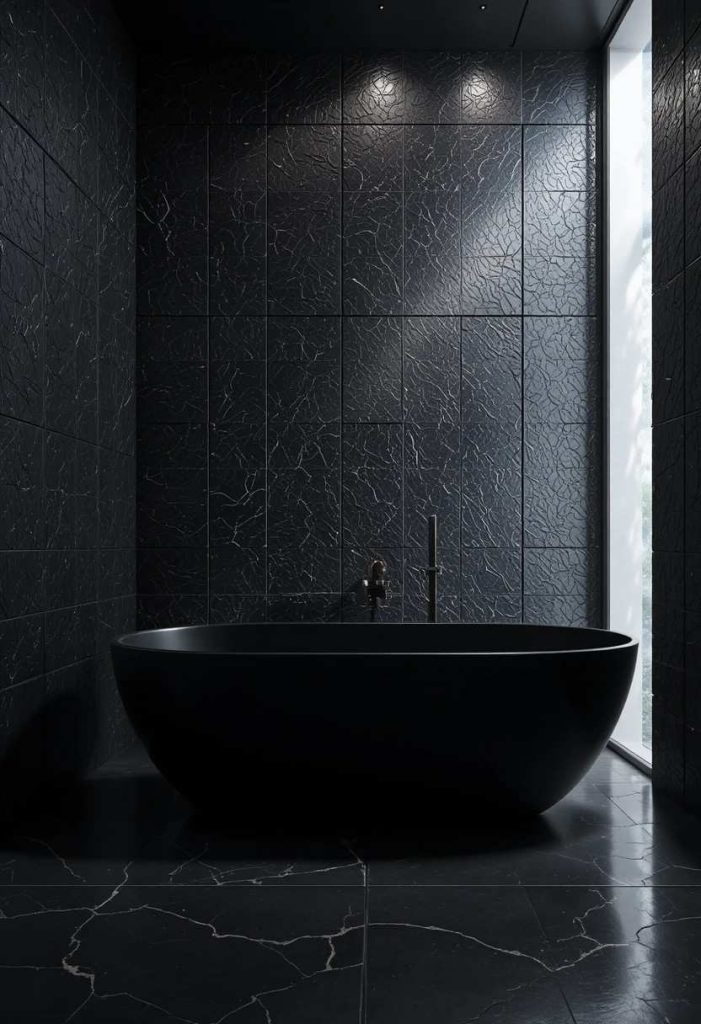
Flat black tile can look a little one-note, which is why texture is my favourite trick in this whole list. Our shower wall uses handmade-look tiles with an uneven glaze, and the surface changes all day as the light moves across it — morning sun picks out ridges you cannot see at night. If handmade texture is what you are after, my zellige tile bathroom ideas show how an uneven glaze catches the light in exactly this way, and black zellige is the boldest version of all. Texture also hides the water marks and fingerprints that flat black shows up so cruelly, which is a practical win as much as a pretty one.
How to do it: Order samples of two or three textured black tiles and tape them to the shower wall for a week, checking them in morning and evening light. Tile one feature area first — the shower wall or the splashback — and keep the remaining walls smooth and pale. Use a grout that matches the darkest tile, and seal the tiles before grouting.
13. Add Soft Towels and Textiles
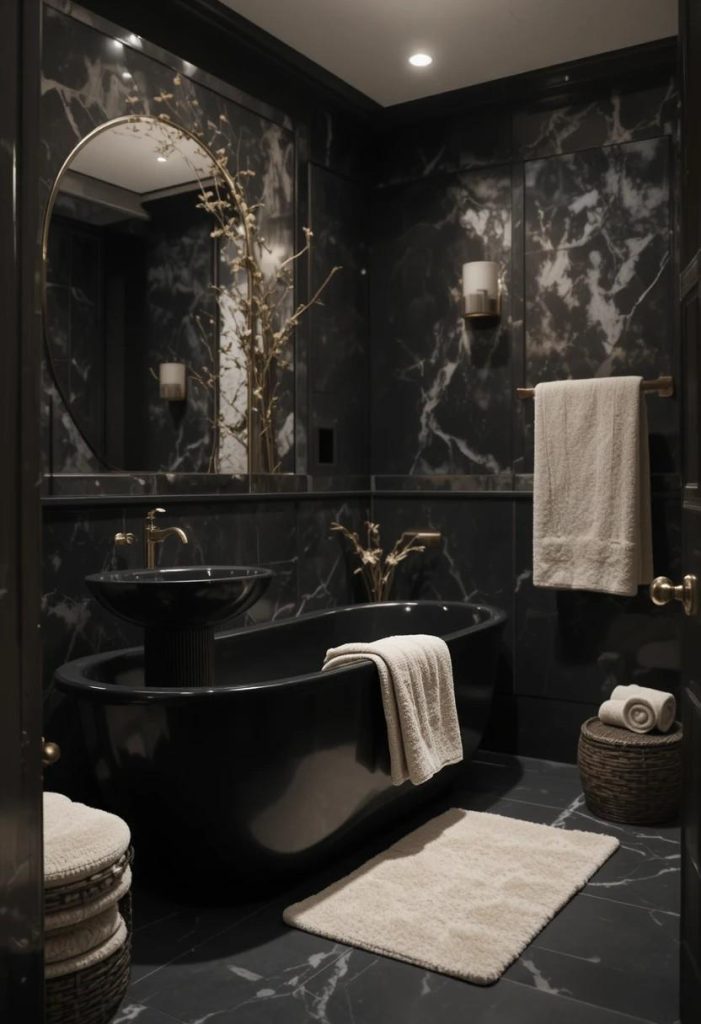
Towels are the lowest-commitment way to change a black bathroom, and the one I reach for whenever the room starts feeling too stark. I keep a stack of thick cream towels folded on an open shelf, and the pale, fluffy pile against the dark wall is the softest contrast in the room. Texture matters as much as colour here: waffle weave, washed linen and a plush bath mat all stop black from feeling hard and glossy. I wash them with a little white vinegar instead of fabric softener, which keeps them absorbent and stops that grey, tired look towels get in a dark room.
How to do it: Layer cream or warm grey towels over a darker hand towel, and add a washable bath mat in a pale, textured weave. Fold a spare set on an open shelf or in a basket so the softness is visible, not hidden in a cupboard. Wash towels without fabric softener to keep them fluffy and absorbent.
14. Try a Black Freestanding Tub
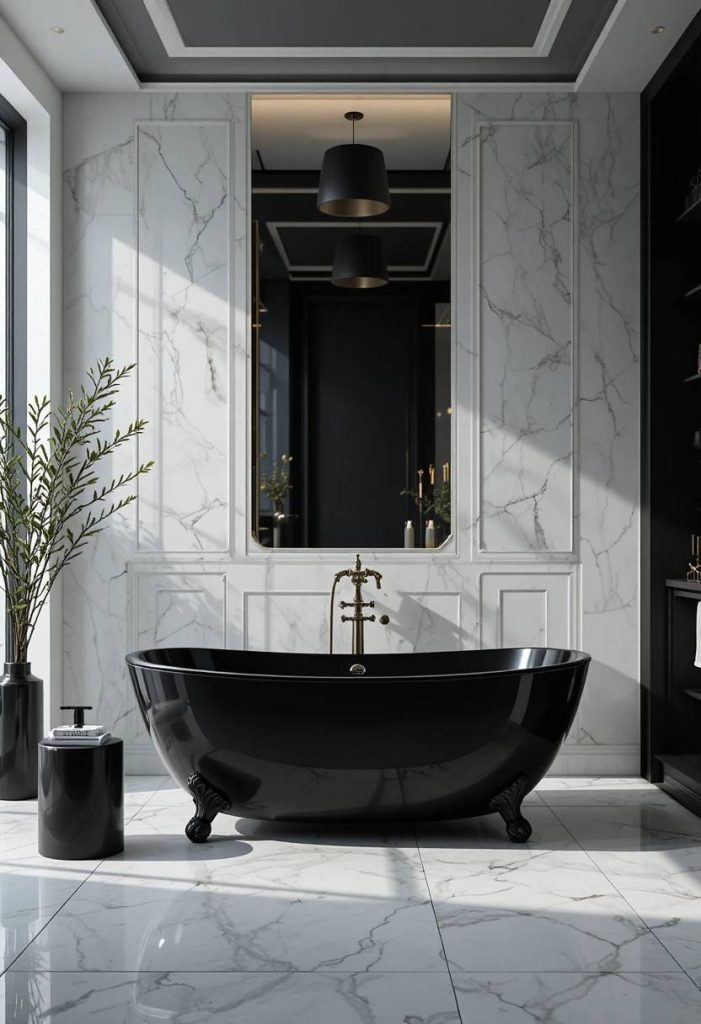
A black freestanding tub is the closest thing to a sculpture you can put in a bathroom, and I still remember the delivery day — two of us, one very narrow hallway, and a lot of held breath. Once it was in, though, the room rearranged itself around it. The dark silhouette of the tub against pale tiles makes the whole space feel designed, and bath time genuinely feels like an occasion now, candles and all. It is the biggest single purchase on this list, so measure twice: you need clear space all around it for cleaning, and a floor that can take the weight when it is full of water.
How to do it: Measure the room and leave at least 15 centimetres clear around the tub for cleaning, checking the floor can take its full weight. Choose a matte black finish, which hides water marks better than gloss, and pair it with a floor-mounted or freestanding tap in brass or matte black. Add a wooden bath tray and keep a non-slip mat nearby.
15. Add Gold-Framed Art
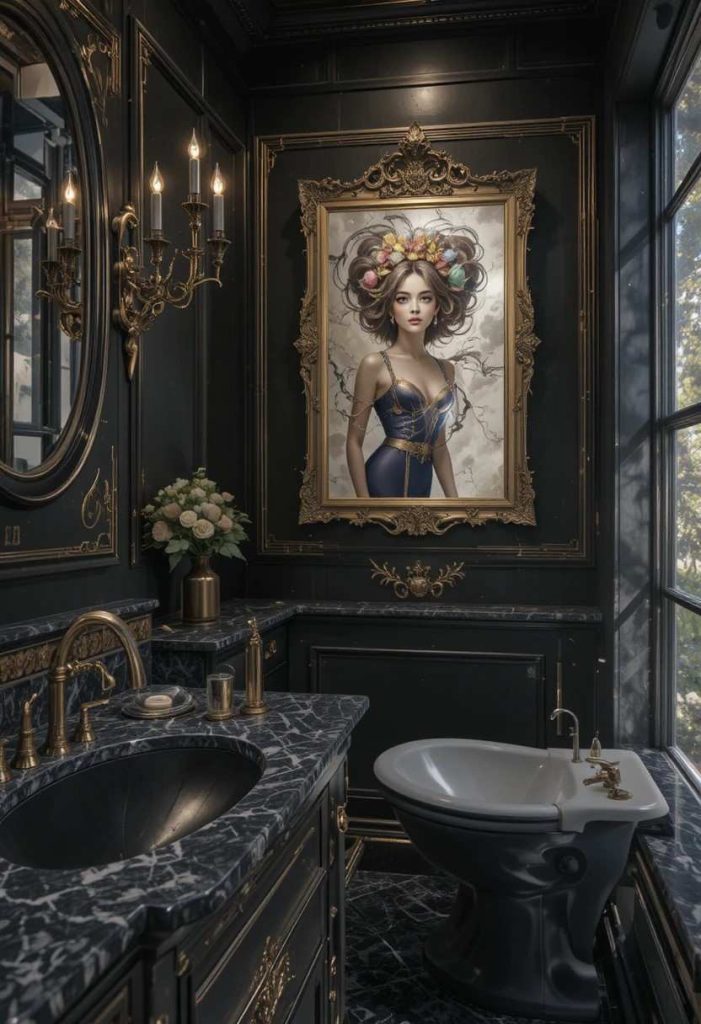
Art was the last thing I added to our black bathroom, and it is the piece guests comment on most. A single print in a slim gold frame hangs on the darkest wall, and the warm metal edge is what stops the wall feeling like a blank expanse — it gives your eye a destination. I chose a botanical print with soft green leaves, because the green echoes the plants on the shelf and keeps the room feeling alive. The frame matters more than the picture, I think: gold against black reads as deliberate and a little bit glamorous, while a black frame would simply disappear into the wall.
How to do it: Choose one framed print, larger than you first think — at least A3 — with a slim gold or brass frame. Hang it on the darkest wall at eye level, centred on the vanity or the bath. Keep the glass slightly tilted or use non-reflective glass so steam and light do not glare on it.
16. Use Black Grout for a Seamless Look
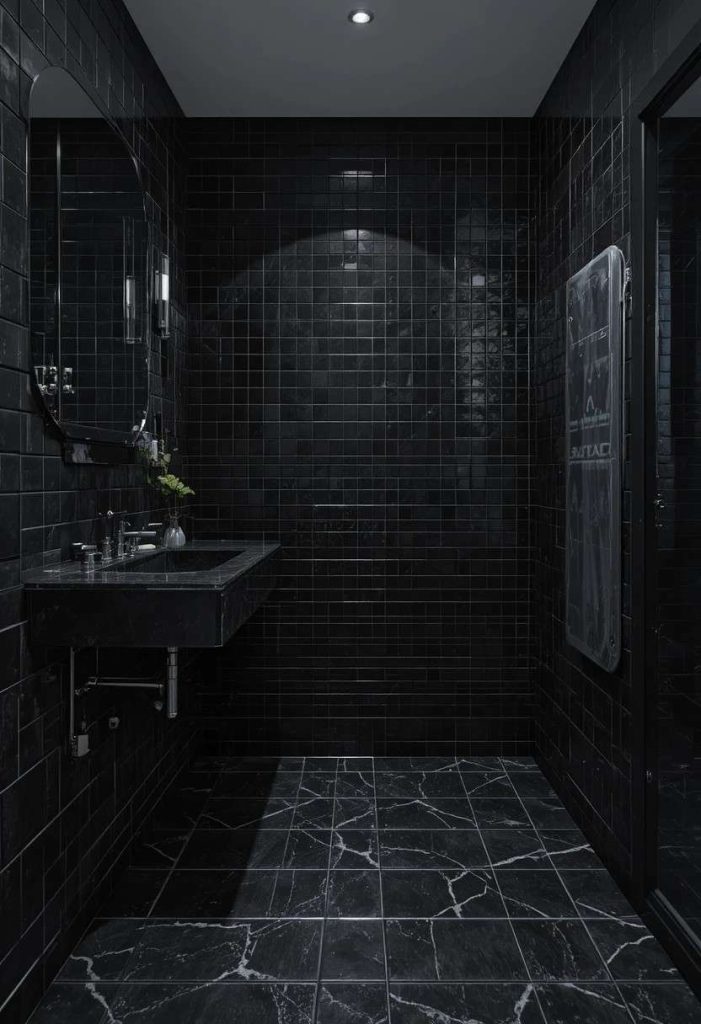
Black grout is the detail nobody notices and everybody feels. When we retiled our shower with black tiles and pale grout, the grid of white lines chopped the wall into squares and made the room look busy; switching to black grout made the same tiles read as one calm, unbroken surface. It is also gloriously practical — it never shows the mildew staining that pale grout picks up in a steamy bathroom. The only place I would not use it is on a pale tile, where it can look harsh, but on black or very dark tiles it is the neatest trick I know.
How to do it: Pair black grout with black or very dark tiles, and test it on a small area first — some black grouts dry grey. Ask your tiler to use a grout float and wipe the tiles clean as they go, since dark grout stains pale surfaces. Seal the grout once cured, and clean it with a pH-neutral cleaner.
17. Add a Touch of Greígé or Stone
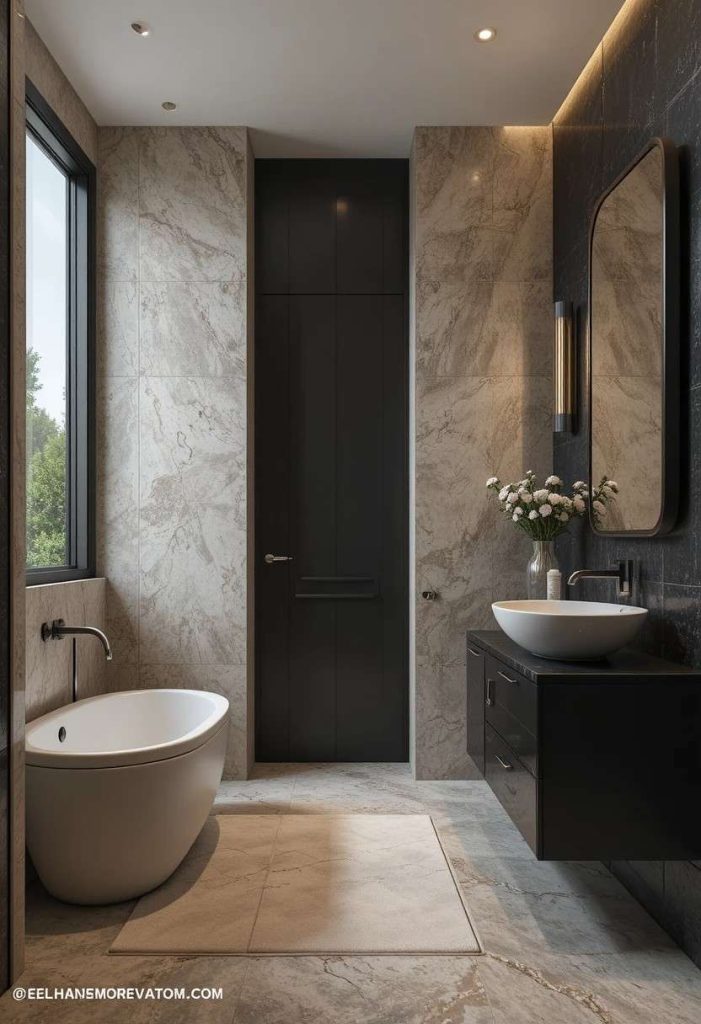
Greige — that soft blend of grey and beige — is the colour I reach for whenever black starts feeling too sharp. In our bathroom it appears in a stone shelf, a woven basket and the pale tiles behind the bath, and each one takes the edge off the dark walls without washing them out. Stone does the same work in a different register: its cool, rough surface makes the black look warmer by contrast, which sounds backwards until you see it. I keep both in small doses, because their job is to bridge the dark and the light, and a bridge only needs to be as wide as the gap.
How to do it: Add greige or stone in two or three small places: a stone shelf, a greige-painted cabinet, or a woven seagrass basket. Choose warm, yellow-based greige rather than cool grey, and test a sample against your black tiles in daylight. Keep the stone sealed in wet areas, and repeat the tone in a towel or mat so it looks intentional.
18. Keep Fixtures Sleek and Minimal
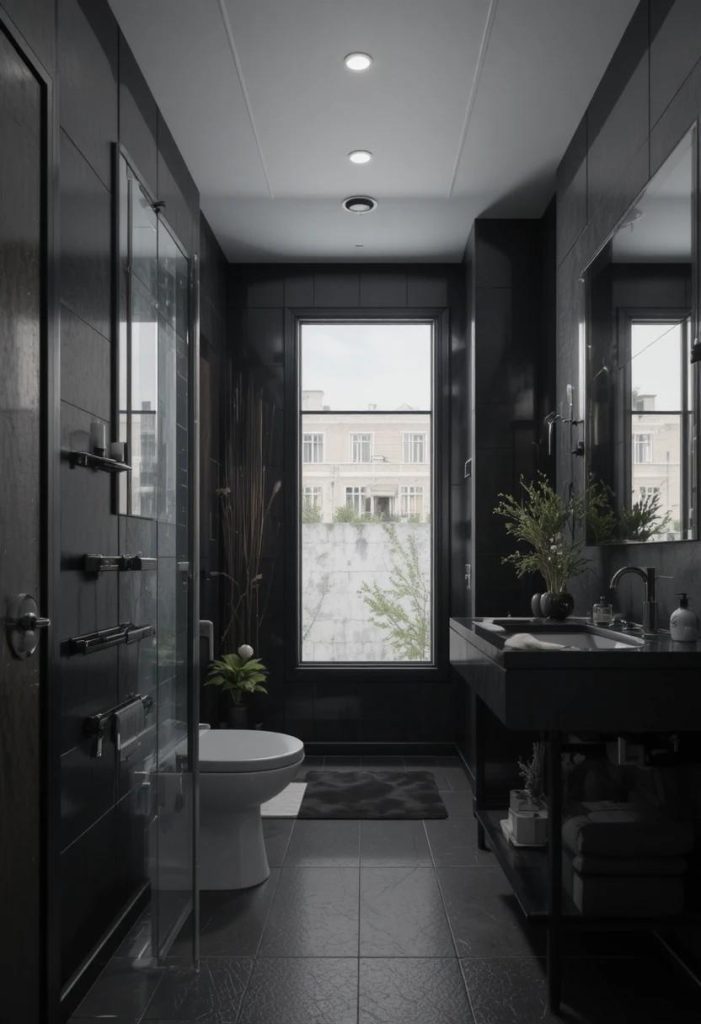
Black shows every fingerprint, every water spot and every fussy detail, which is why I keep our fixtures as simple as I possibly can. A single-lever tap, a handleless vanity and a plain shower head do not compete with the dark walls — they let the colour be the star. I learned this after buying ornate handles that looked wonderful in the shop and merely cluttered in the bathroom; swapping them for slim black bars changed the whole room for the price of a takeaway. Restraint is not boring here. In a black bathroom, a clean line is the decoration.
How to do it: Choose one simple silhouette for taps, handles and the shower head, all in the same matte black or brass finish. Remove anything you do not use daily from the surfaces, and store the rest in a drawer or basket. Wipe fixtures dry after showering to prevent water spots, and check that replacement parts are easy to find.
19. Add a Cozy Bath Mat
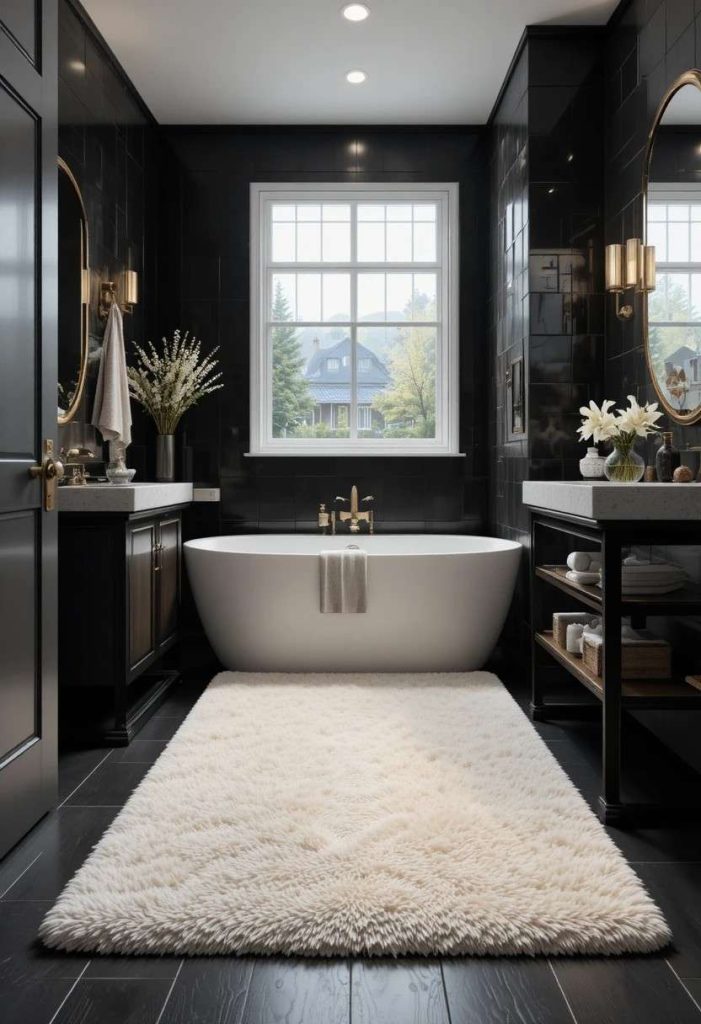
There is nothing quite like stepping out of a hot bath onto a cold tile floor, and in a black bathroom the shock is somehow worse — the dark floor looks warm and is not. A thick, washable bath mat fixed that for me in one purchase, and it also gave the room a pale, soft patch that breaks up the black underfoot. I chose a cream waffle-weave mat because it dries fast, hides nothing, and looks far more expensive than it was. It lives just outside the shower door, and I shake it out every morning and wash it every weekend, which keeps it fresh and the floor beneath it dry.
How to do it: Choose a washable mat in cream or warm grey with a textured weave, sized to the space in front of the bath or shower. Hang it over the bath edge or a heated rail after use so it dries fully, and wash it weekly. Avoid rubber-backed mats on heated floors, and replace the mat when the backing starts to crumble.
20. Use Candles for Ambiance
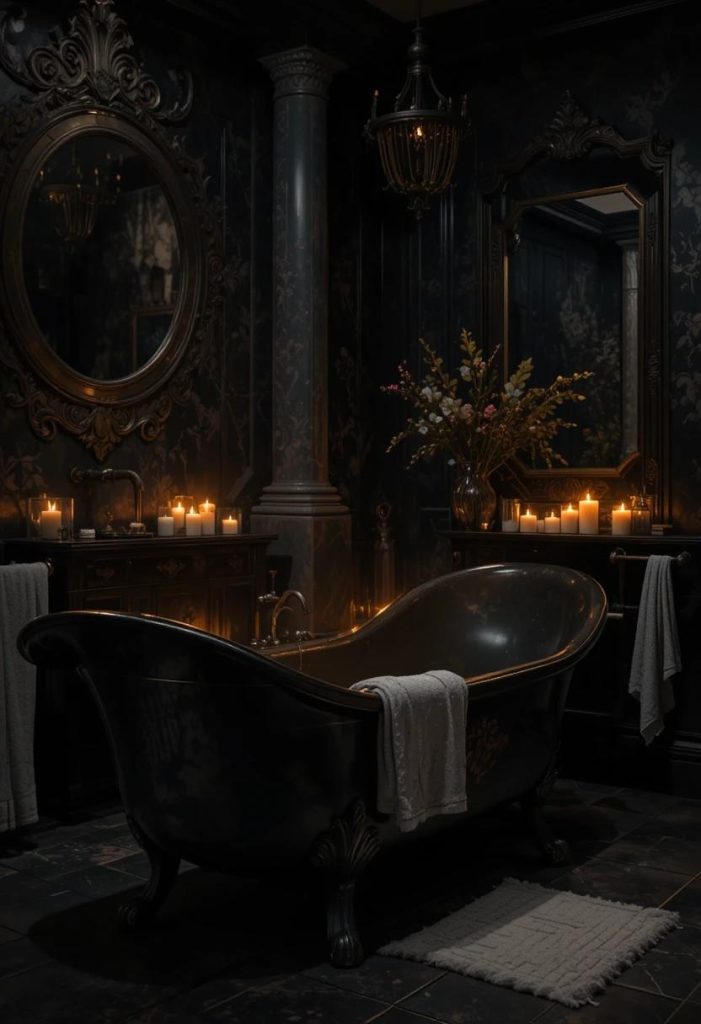
Candles are the only light in our bathroom that cost almost nothing and changed the mood completely. On dark winter evenings I light two on the bath edge — one in a tall glass jar, one in a squat ceramic holder — and the black tiles catch the flicker and throw it back as a warm, uneven glow. No electric light does that. I keep them well away from towels and the shower curtain, and I never leave them burning when I leave the room, because a beautiful bathroom is not worth a singed towel. A wood-wick candle is my favourite here: it crackles softly, like a tiny fireplace.
How to do it: Place two or three candles in sturdy glass or ceramic holders on the bath edge or a high shelf, well away from towels, curtains and the shower. Choose wood-wick or soy candles in a warm scent such as cedar or amber. Never leave candles burning unattended, and trim the wick before each use for a clean flame.
21. Add Reflective Accents
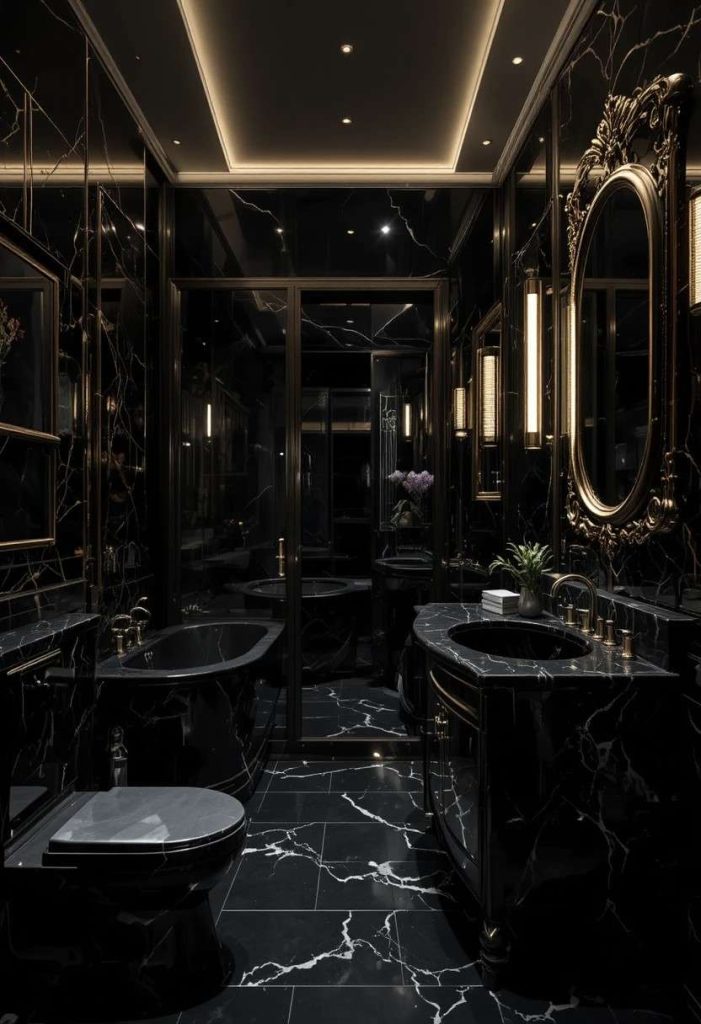
Gloss is black’s best friend, because a shiny surface borrows light from the rest of the room and hands it back. I noticed this by accident: a mirrored tray I bought for perfume sat on the vanity for a week, and the whole corner looked brighter for it. Now the room has a glossy black soap dish, a mirrored tray and a polished tap, each one catching a little window light and scattering it across the dark tiles. The rule I follow is one shine per surface — a glossy tile wall with a matte floor, a mirrored tray on a matte vanity — so the room sparkles instead of glaring.
How to do it: Add one reflective piece per surface: a mirrored tray on the vanity, a glossy soap dish by the basin, or a polished tap. Pair glossy accents with matte black walls or floors so the shine stands out. Keep mirrors and glass wiped clean weekly, since smears show up far more on dark backgrounds.
22. Try Black and Botanical Wallpaper
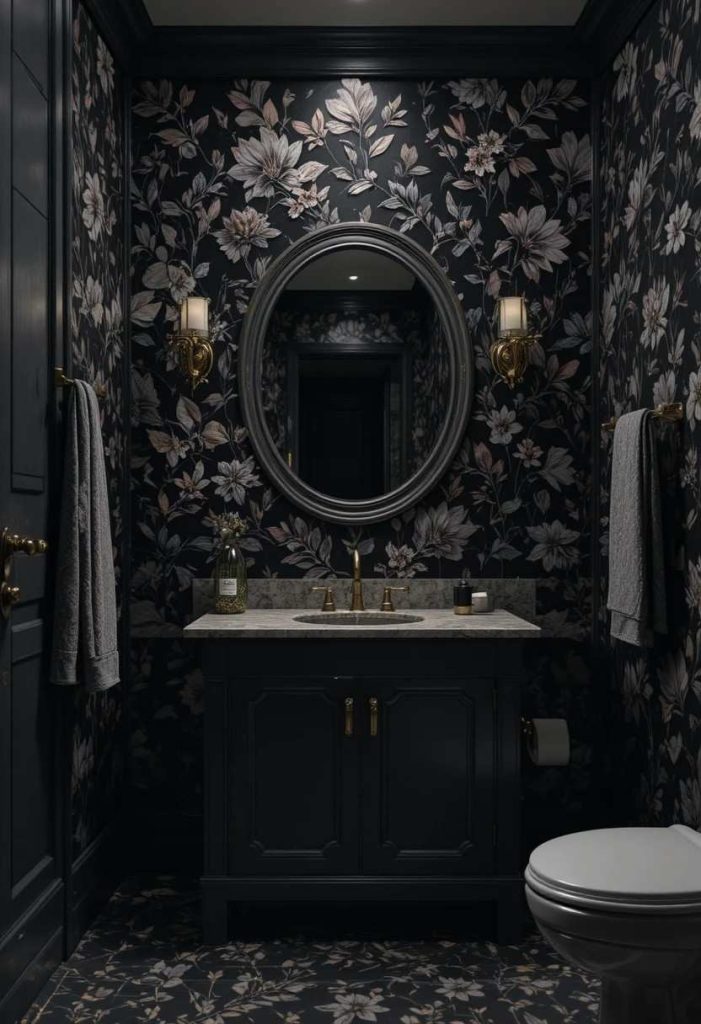
Botanical wallpaper was my boldest choice in this bathroom, and the one I agonised over longest. A dark paper with oversized leaves covers the wall opposite the mirror, and against it the black vanity and brass taps look like they were chosen to match — the paper ties the whole room together. I chose a paste-the-wall vinyl designed for bathrooms, because ordinary paper and steam are not friends, and two years on there is not a single peeling corner. If a whole wall feels too much, paper the wall above the dado line or a single alcove; even a small patch of pattern changes the room.
How to do it: Choose a bathroom-suitable vinyl wallpaper in a dark botanical print, and paper one wall only — ideally the one opposite the mirror. Check the paper is rated for humid rooms, and seal the edges with a clear bathroom sealant. Keep the remaining walls plain, and match one colour from the paper in a towel or plant pot.
23. Add Warm Wood Stool or Ladder
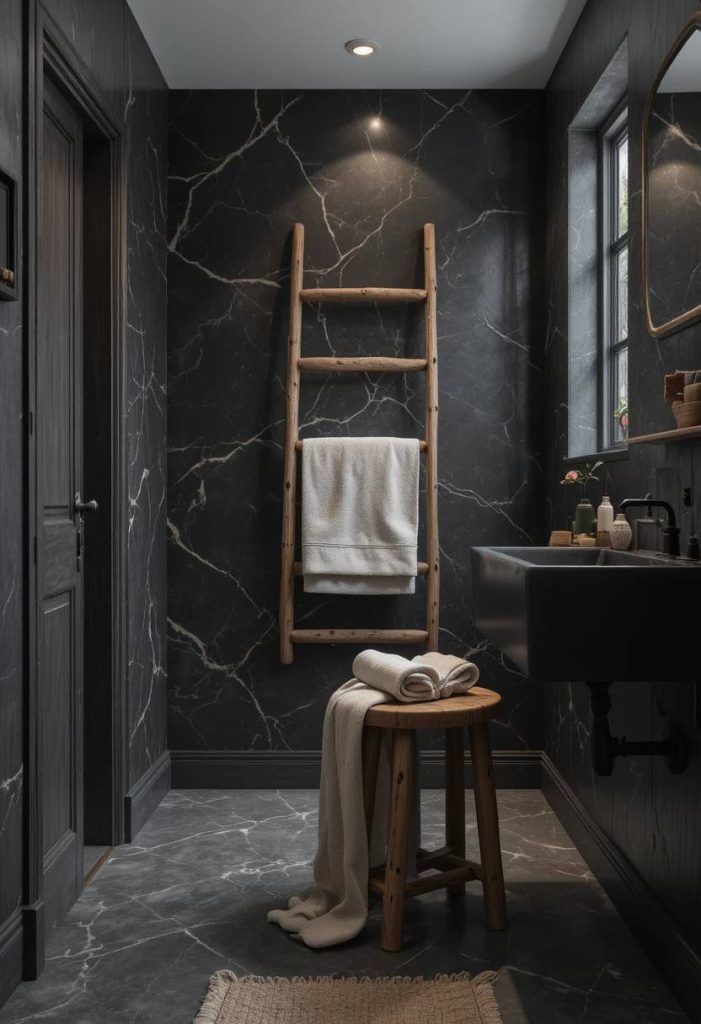
A wooden stool is the hardest-working piece of furniture in our bathroom, and it cost less than a dinner out. It holds a folded towel, a book and a cup of tea while I soak; it becomes a step for the high shelf when I need it; and on the days I cannot be bothered to tidy, it hides the clutter behind it. The towel ladder does the same job vertically: it keeps towels aired and off the floor, and its warm timber rungs are the prettiest contrast to the black tiles. Both pieces are light enough to move when I clean, which matters more than I expected in a small room.
How to do it: Choose a solid wood stool or ladder in the same wood tone as your other timber pieces, and seal it against steam. Place the stool beside the bath and the ladder on the warmest, driest wall, away from direct shower spray. Fold towels loosely over the rungs so air circulates, and oil the wood twice a year.
24. Keep It Spa-Like and Serene
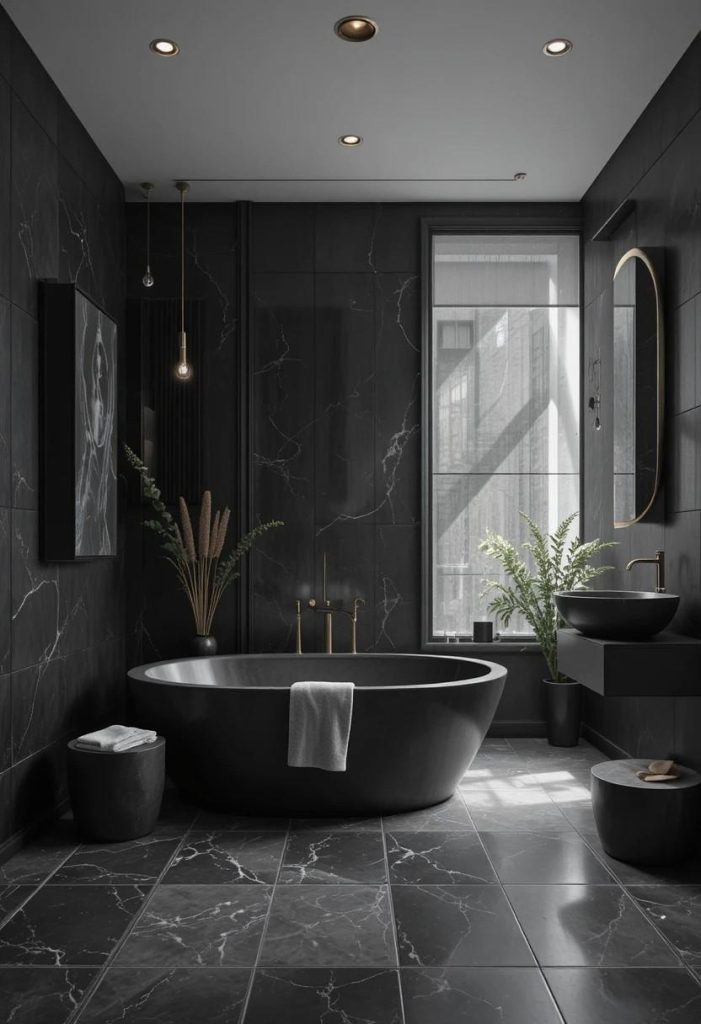
A spa is not a place, I have decided; it is a set of habits. In our black bathroom the spa feeling comes from what I removed, not what I added: the cluttered shelf went, the half-empty bottles went, and what stayed was a folded stack of towels, a wooden tray and one small plant. Dark walls help, oddly, because they hide the edges of the room and make the candlelight and the steam the whole show. I keep the lighting low in the evenings, run the bath hotter than is sensible, and give myself twenty minutes. It is the cheapest holiday I know.
How to do it: Clear every surface, then add back only a candle, a folded towel, a wooden tray and one plant. Put the main light on a dimmer and keep it low in the evenings. Store bottles and cleaning products out of sight, and keep a soft robe on a hook by the door so the ritual starts the moment you walk in.
25. Add Personal, Gentle Touches
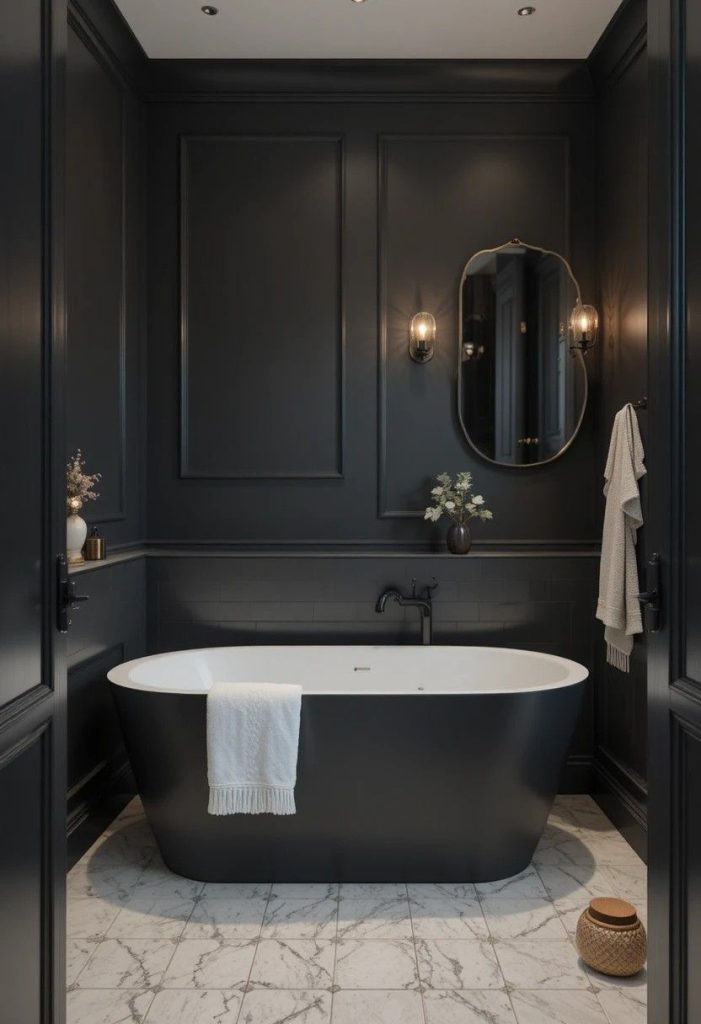
After all the paint and tile and brass, the thing that makes our black bathroom feel like ours is the smallest stuff: a chipped ceramic dish that holds my rings, a photograph of my grandmother’s garden taped inside the cabinet door, and a bottle of the lavender oil I have used since university. None of it matches, and none of it needs to. Black is a generous backdrop — it makes ordinary, loved objects look intentional, the way a dark frame makes a small drawing look important. Add the pieces that mean something to you, and the room will never feel like a showroom, however dark the walls.
How to do it: Choose two or three personal pieces — a favourite scent, a handmade dish, a framed photo — and give each one a proper place, such as a shelf, a tray or the windowsill. Keep the rest of the surfaces clear so these pieces stand out. Swap one piece with the seasons so the room keeps feeling like yours, not a display.
Frequently Asked Questions
Will a black bathroom make a small bathroom feel smaller?
Not necessarily. One black wall, or black used low down with pale walls above, keeps the room feeling grounded rather than closed in. A large mirror, good lighting and pale towels do most of the work. I would avoid painting every surface black in a windowless room, but a small bathroom can absolutely carry black.
What colours go best with black in a bathroom?
Warm white, cream and pale wood soften black beautifully, while brass and gold add warmth and a little glamour. Sage green and soft stone tones work well too, because they bring nature in without competing. I keep to one metal and one wood tone so the room stays calm.
Is matte or gloss black better for a bathroom?
Matte black feels soft and modern, and it hides fingerprints and water marks better than gloss, so I use it for walls, vanities and taps. Gloss black suits tiles and accessories, where its shine bounces light around the room. Mixing the two finishes is what stops black from looking flat.
How do I keep a black bathroom from looking too dark?
Layer the light: sconces at the mirror, a ceiling light on a dimmer and a low glow for evenings. Keep the ceiling white, add a large mirror, and let pale towels and wood break up the dark. In our bathroom the white basin and a pale bath mat do more brightening than any extra bulb.
Are black bathroom fixtures hard to keep clean?
Matte black hides water spots far better than chrome, but limescale can still show as pale marks in hard-water areas. A quick wipe with a soft cloth after showering and a weekly clean with a gentle, non-abrasive cleaner keeps them looking new. Avoid scouring pads and bleach, which can damage the finish.
Your Black Bathroom Checklist
Work through this list before you start, and tick each step off as you go.
- ☐ Choose where the black goes: one feature wall, the vanity, or accents only
- ☐ Test matte black paint samples in morning and evening light
- ☐ Keep the ceiling white and leave at least one wall pale
- ☐ Pick one metal finish — brass, gold or matte black — and use it throughout
- ☐ Choose warm 2700K bulbs and fit a dimmer on the main light
- ☐ Add a large mirror at eye level to bounce light around the room
- ☐ Pair black tiles with matching grout for a seamless finish
- ☐ Bring in warm wood in one tone: a stool, tray or towel ladder
- ☐ Layer soft textiles — cream towels and a washable bath mat
- ☐ Add one living plant that loves humidity
- ☐ Seal tiles and grout in wet areas, and wipe taps dry after use
- ☐ Add two or three personal touches that make the room yours
A Final Gentle Thought
A black bathroom asks for a little bravery at the start and rewards you every single day after. I still smile when I walk into ours in the morning, because the dark walls make the steam, the candlelight and even an ordinary white towel feel like a small occasion. Start with the one idea that made you pause — a painted wall, a brass tap, a black tub — and build the rest around it slowly. Black is not a colour you have to commit to all at once; it is a backdrop that lets everything else in the room shine. I hope yours ends up feeling bold, calm and unmistakably yours.