
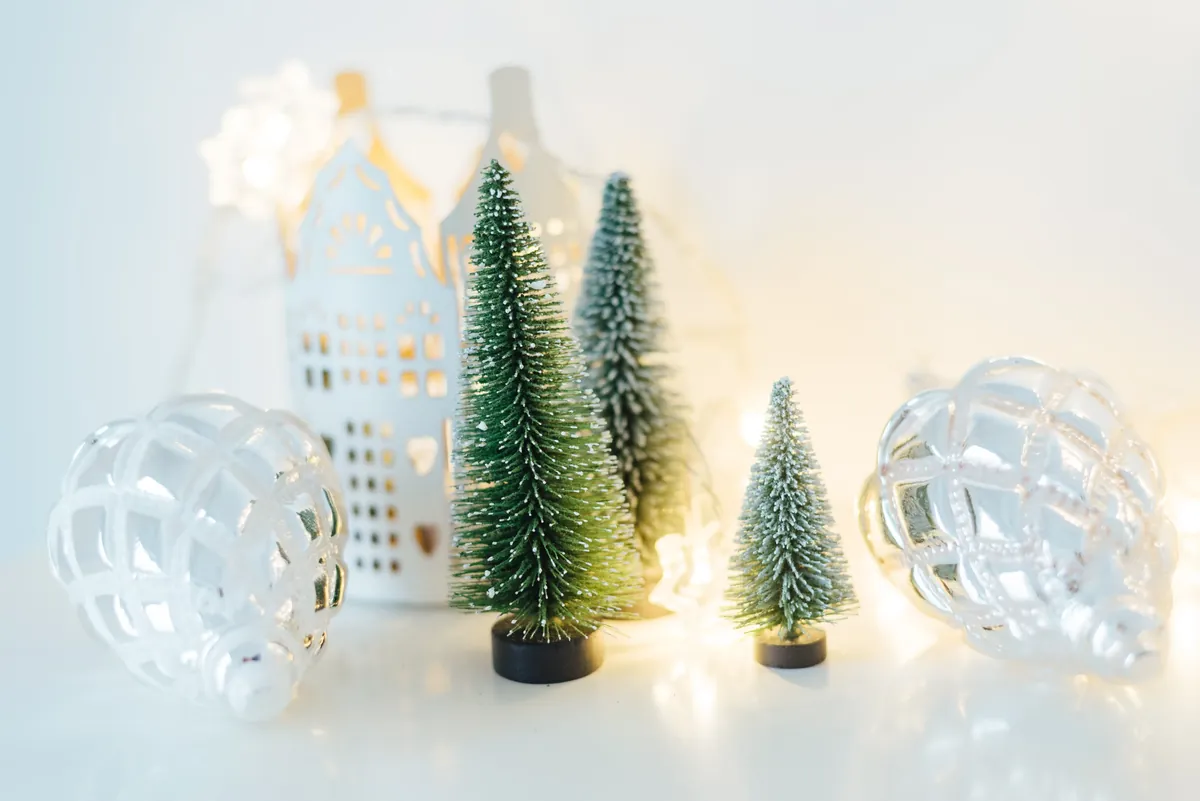
23 Small Christmas Tree Ideas
I used to think a small Christmas tree meant settling for less Christmas, and I could not have been more wrong. The year I moved into a flat with a living room barely big enough for a sofa, I bought a little two-foot tree, set it on the sideboard, and discovered something lovely: a small tree gets decorated with more care than a big one ever does. Every bauble is chosen, every light is placed on purpose, and the whole thing glows like a jewel instead of getting lost in a corner. Below are twenty-three small Christmas tree ideas, each with a real photo, honest costs and simple steps — from classic tabletops to windowsill trees, budget minis and one very cheerful cactus companion. Pick the one that fits your space, and start there.
This post may contain affiliate links. As an Amazon Associate I earn from qualifying purchases, at no extra cost to you.
Start Here: Find Your Small Tree in 30 Seconds
Not all 23 ideas fit every home, and you do not need all 23. Find your type, then start with its ideas first:
- Tabletop and windowsill: Ideas 1, 4, 6, 19, 20 — trees that live on furniture, not on the floor
- Small living rooms: Ideas 2, 5, 18 — the main tree, just scaled down
- Calm and minimal: Ideas 3, 7, 22 — few ornaments, quiet colours, breathing room
- Bold and colourful: Ideas 10, 11, 12, 13 — jewel tones, red-on-red, Santa and rainbow lights
- Natural and handmade: Ideas 16, 21, 23 — burlap, potted trees, dried orange and cinnamon
- Quick and budget-friendly: Ideas 9, 15, 22 and the 15-minute tabletop tree at the end
If the rest of your home still needs its Christmas layers, my 27 Christmas living room ideas and 26 Christmas mantel decor ideas use the same warm, layered approach room by room.
1. The Classic Tabletop Tree
Some Christmas traditions are classics for a reason, and the little tabletop tree is one of them. Mine sits on the sideboard every December — a two-foot tree with warm fairy lights, a dozen small baubles and a star on top — and it is the first thing I see when I come home in the dark. The reason it works so well is scale: a small tree on a tabletop sits at eye level, so every ornament is visible and nothing gets lost behind the sofa. I keep the baubles to one colour family and let the lights do the talking, and the whole corner feels festive without a single extra decoration.
How to do it: Set a 2 ft tabletop artificial Christmas tree on a sideboard or console, then wrap one short string of warm fairy lights around it from the top down. Hang twelve small baubles in one colour family, add a star topper, and tuck a folded cloth or small tree skirt under the pot to hide the base. Check the latest price on Amazon before you buy.
Cost: $20–$55 · Time: 20 minutes
2. The Living-Room Corner Tree
When the living room is small, the corner is your best friend, and a slim four-foot tree fits there beautifully. I moved my tree into the corner two years ago and never looked back — it freed up the whole middle of the room, and the tree still reads as the main event because the lights catch the wall behind it and throw a soft glow across the sofa. The trick is choosing a slim or pencil tree rather than a wide one, and keeping the ornaments small so the branches do not look crowded. It feels like a proper Christmas tree, because it is one, just in the right size for the room.
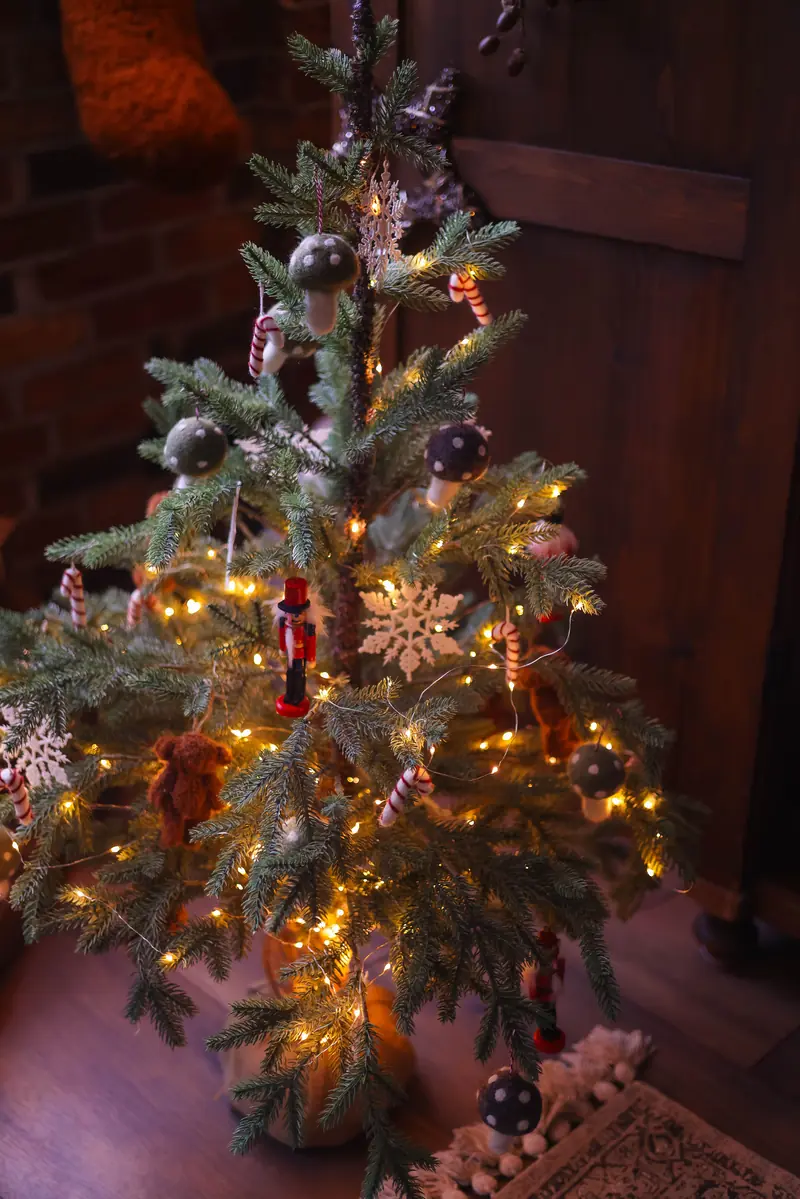
How to do it: Place a 4 ft slim artificial Christmas tree in the brightest corner of the room, angled so the fullest side faces the sofa. Wrap warm white lights around it, hang small baubles in two colours, and set the wrapped gifts at its base — the presents do half the decorating for you. Check the latest price on Amazon before you buy.
Cost: $35–$90 · Time: 45 minutes
3. The Minimalist Small Tree
There is a quiet kind of Christmas that I come back to every few years, and it starts with a small tree and almost nothing on it. A few pale baubles, one string of warm lights, a plain star — and suddenly the tree looks like it belongs in a magazine, not because it is expensive but because every single thing on it was chosen on purpose. A small tree with five ornaments looks intentional, while a big bare tree just looks unfinished. Keep the palette to white, wood and one soft colour, and let the empty branches be part of the design.
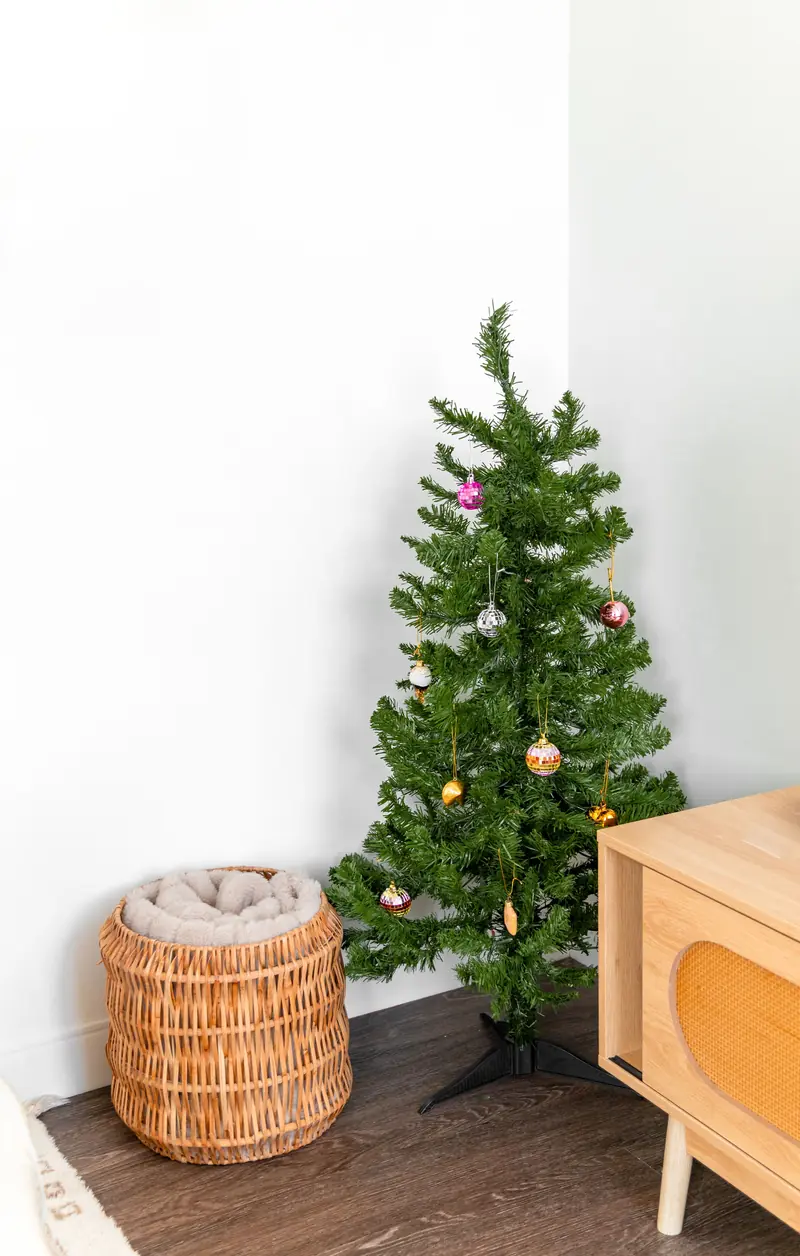
How to do it: Choose a small tree with space between the branches, then hang just six to eight mini Christmas tree ornaments in white, wood or one soft colour. Add one short string of warm lights, a simple star on top, and nothing else — step back and resist adding more, because the empty space is doing the work. Check the latest price on Amazon before you buy.
Cost: $25–$60 · Time: 20 minutes
4. The Windowsill Tree
My favourite small-tree spot in the whole house is the windowsill, and I wish I had tried it years earlier. A little tree on a wide sill catches the daylight all afternoon and glows from the street after dark, so you get two completely different trees for the price of one. The gifts tucked around its base make it feel like a proper Christmas scene rather than a decoration that wandered off, and because the window frames it, even the simplest tree looks finished. Just measure the sill first — a tree that is wider than the sill will spend December wobbling, and nobody needs that kind of suspense.
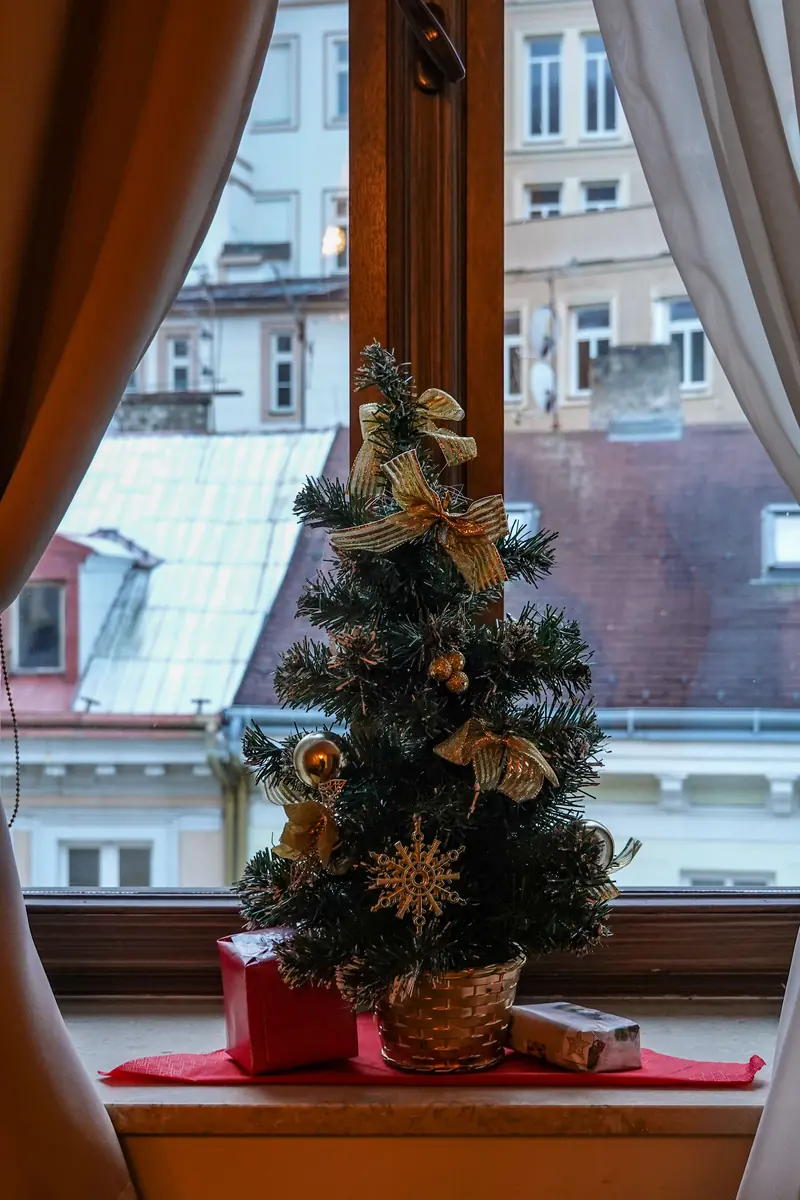
How to do it: Pick a tree no wider than your sill and set it in a heavy pot so it cannot tip, then wrap battery fairy lights around it — battery lights mean no trailing wire across the window. Hang small baubles, place two or three wrapped gifts at the base, and switch the lights on at dusk so the tree glows for the street. Check the latest price on Amazon before you buy.
Cost: $20–$50 · Time: 25 minutes
5. The Sofa-Side Tree
Some trees are for looking at from across the room, and some are for sitting beside, and I love a sofa-side tree more than I can explain. Ours stands on a little cabinet at the end of the sofa, close enough to straighten a bauble while you watch television, and the gold ornaments catch the lamplight so the whole room feels expensive. The wrapped gifts at its base turn a decorated tree into a Christmas scene and hide the tree stand completely. Keep the baubles to gold and one deep colour so it feels rich rather than busy.
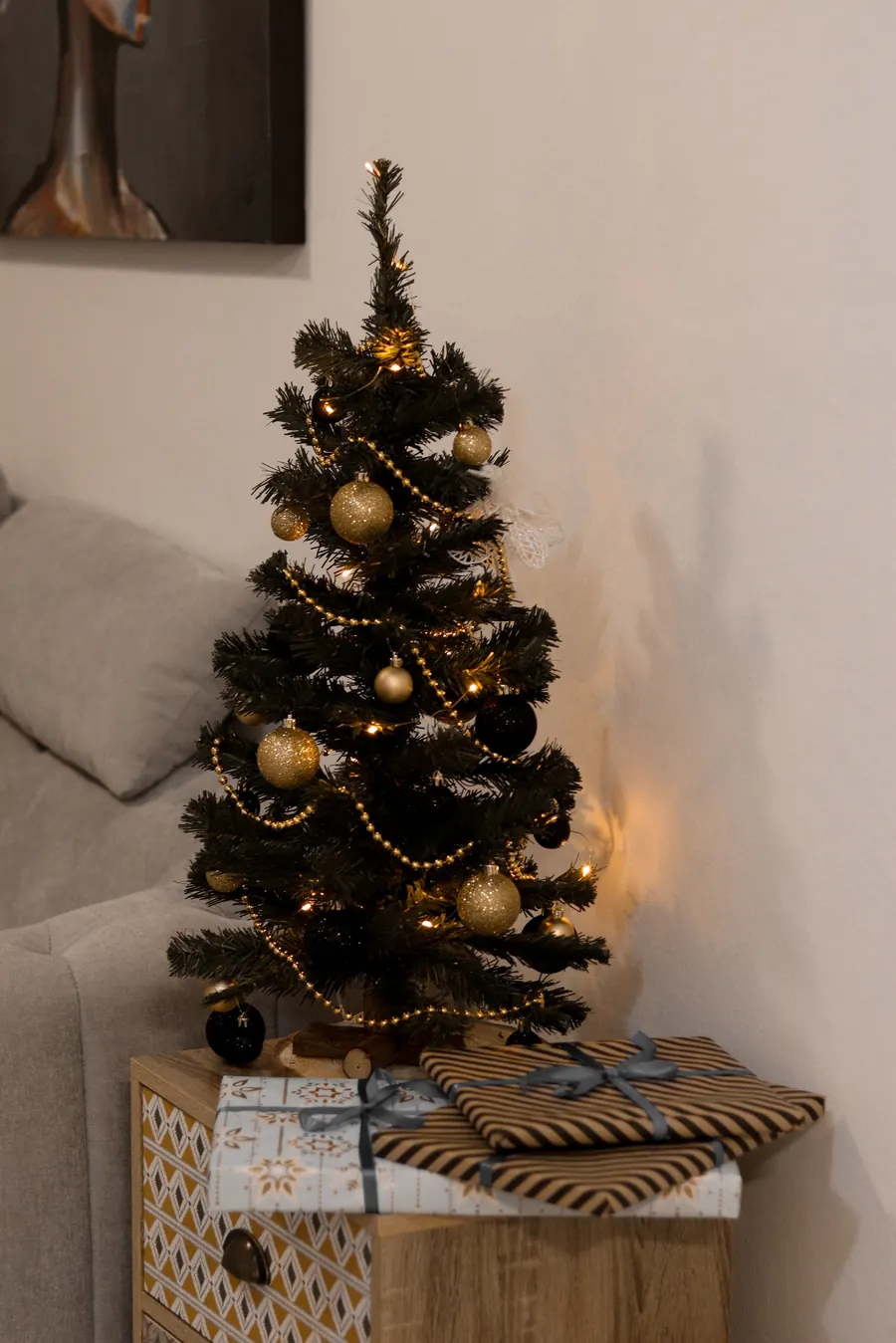
How to do it: Set a small tree on a sturdy cabinet beside the sofa, then hang gold Christmas baubles in two sizes — the mix of sizes is what makes it look expensive. Add warm lights, a small star, and stack the wrapped gifts around the base so the stand disappears. Check the latest price on Amazon before you buy.
Cost: $30–$70 · Time: 30 minutes
6. The Cabinet-Top Tree
A cabinet-top tree is the grown-up version of the tabletop tree, and it is perfect for anyone who wants Christmas to feel elegant rather than cute. Mine lives on the hallway cabinet where everyone sees it coming in the door, and the gold and white palette makes it look like it belongs in a hotel lobby — in the best way. The secret is height: a cabinet already lifts the tree to eye level, so even a two-foot tree reads as a real statement. I keep the ornaments to gold, cream and glass, because restraint is what makes this one feel expensive.
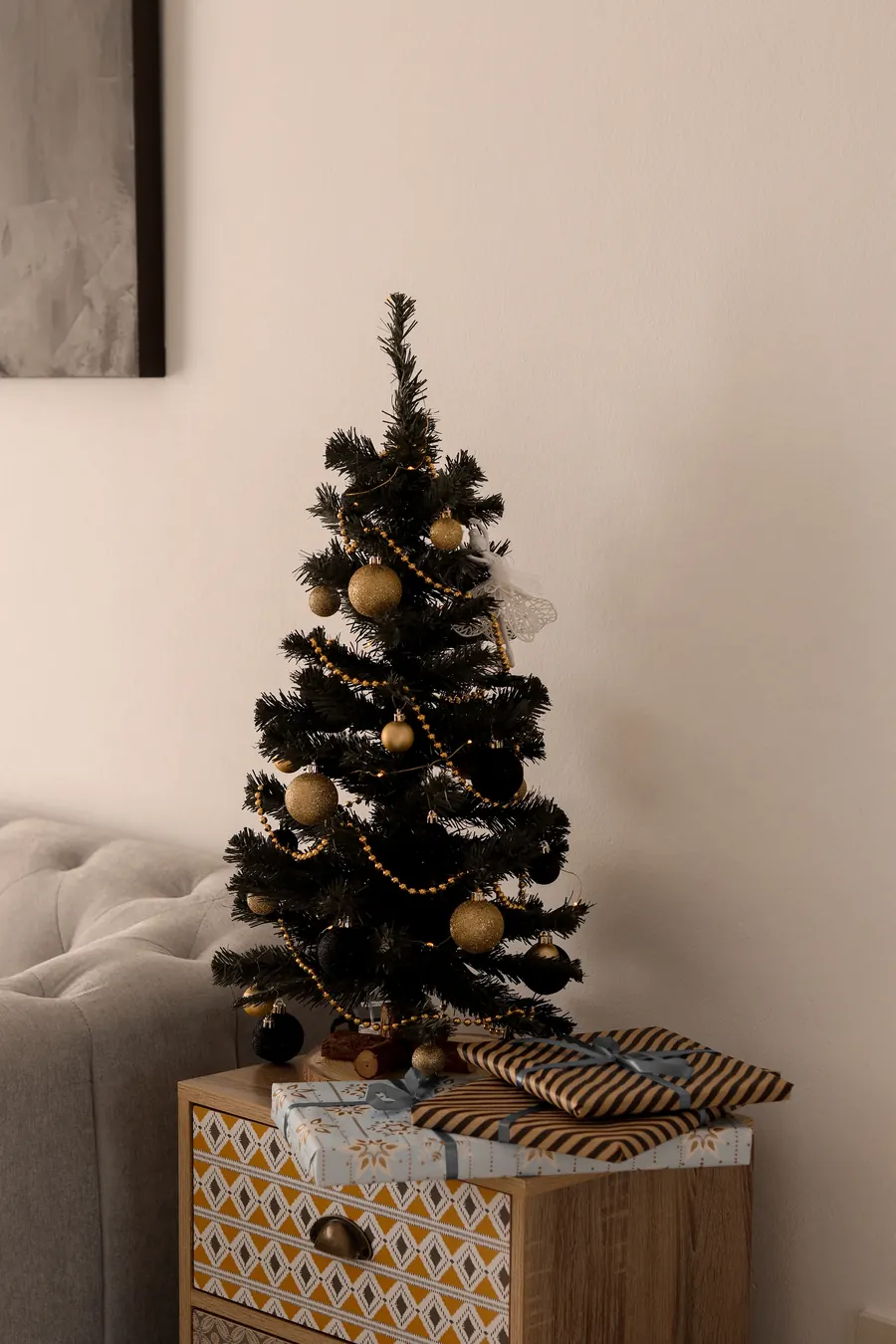
How to do it: Place a small tree on a hallway or living-room cabinet, then top it with a small gold Christmas tree topper star. Hang gold and cream baubles, add warm lights, and arrange the wrapped gifts on the cabinet top around the base so the whole surface feels dressed. Check the latest price on Amazon before you buy.
Cost: $30–$75 · Time: 30 minutes
7. The Scandinavian Bare-Branches Tree
Scandinavian Christmas taught me a tree does not need to be covered to be beautiful — sometimes it just needs to breathe. This is the tree for the person who loves white walls, pale wood and quiet mornings: a small tree with bare branches showing between a handful of simple ornaments, a paper star, and nothing competing for attention. I tried it the year I was tired of glitter everywhere, and the room felt calm — the tree looked like winter itself, all pale green and soft light. Choose a tree with widely spaced branches: a dense tree with five ornaments looks empty, while a sparse tree with five looks deliberate.
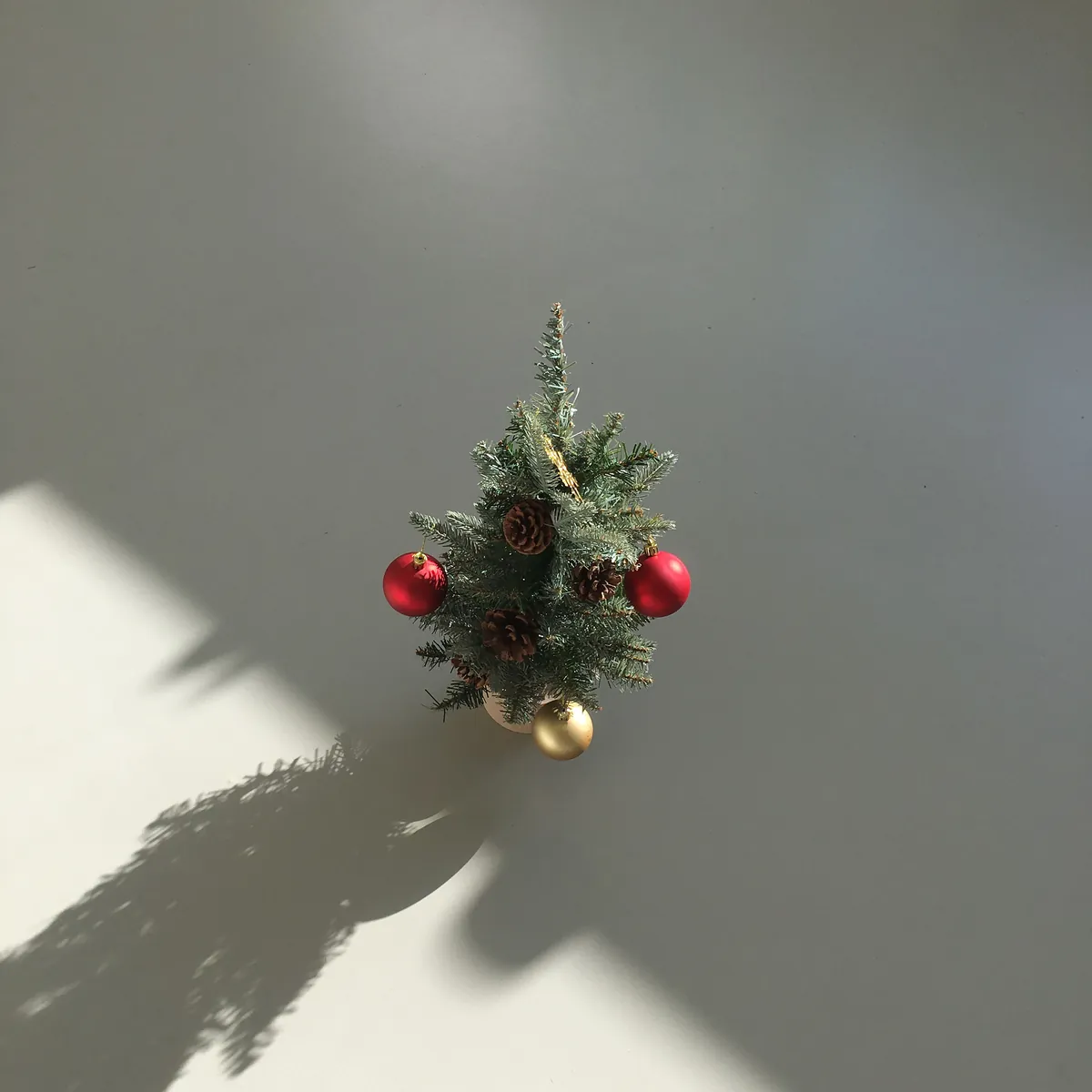
How to do it: Choose a sparse-branch small tree and hang five to seven Scandinavian wooden Christmas ornaments — stars, hearts and simple shapes in natural wood and white. Add one short string of warm lights and a paper star on top, then leave the branches open so the shape of the tree shows. Check the latest price on Amazon before you buy.
Cost: $25–$60 · Time: 20 minutes
8. The Decorate-It-Together Tree
The best small-tree memory I have is not of a finished tree at all — it is of an afternoon spent decorating one with my family, baubles everywhere, someone reaching too high, someone else insisting the star goes on crooked. A small tree is the perfect size for decorating together because everyone can reach every branch, including the children, and nobody needs a step ladder or a long debate about the top third. I keep a box of unbreakable ornaments just for this afternoon, put on some music, and let everyone hang their favourites wherever they like. The tree always looks a little lopsided, and it is always my favourite one in the house.
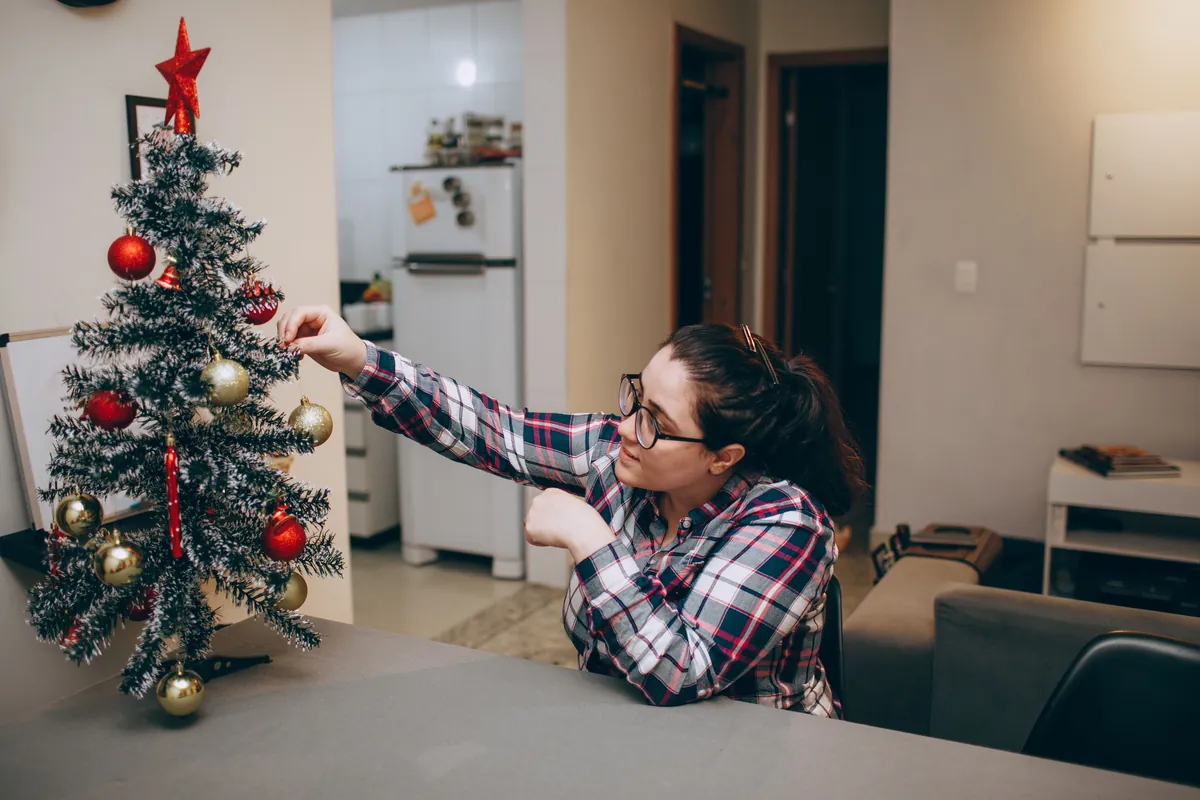
How to do it: Set the tree at table height where everyone can reach it, then hand out a box of shatterproof Christmas ornaments — no glass, no tears when one drops. Let each person hang their own ornaments, add the lights first so the branches are easy to see, and save the star for the smallest person in the room. Check the latest price on Amazon before you buy.
Cost: $20–$50 · Time: 1 hour of happy chaos
9. The Quirky Cactus-Companion Tree
Not every Christmas tree has to be serious, and this one is my reminder of that. A cluster of tiny trees next to potted cacti should not work, and yet it does — the deep green of the cacti picks up the green of the trees, the red bows pop, and the whole display feels playful in a way a traditional tree never could. I love this for a sunny room or a plant lover’s home, where a big formal tree would feel out of place. Keep the trees tiny and the bows bright, and let the plants do the talking.
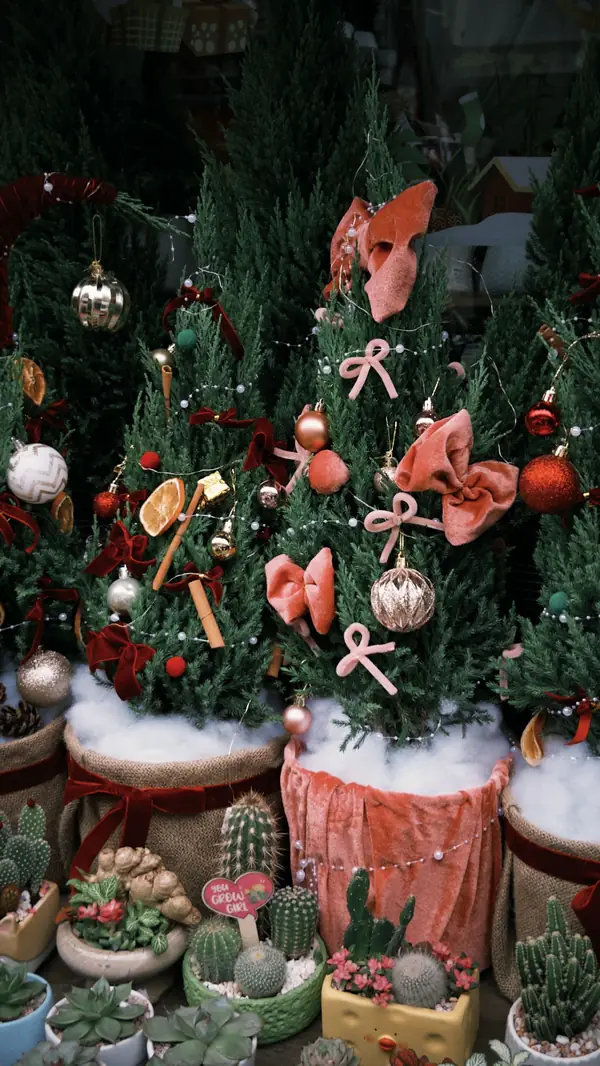
How to do it: Group three mini Christmas trees in a 3 pack on a shelf among your houseplants, tie a small red bow on each one, and hang two or three tiny baubles per tree. Add a short string of fairy lights across the shelf so the whole display glows together, and leave the cacti exactly where they are. Check the latest price on Amazon before you buy.
Cost: $15–$40 · Time: 15 minutes
10. The Jewel-Tone Tree
If you want a small tree that stops people in their tracks, forget red and green and go jewel-toned. Deep red, gold and emerald baubles against dark green branches look like something from a boutique hotel, and the dark background of a winter evening makes the colours glow even brighter. I decorated one for a dinner party and guests kept walking over to look at it — rich colours photograph beautifully and feel far more expensive than they are. The trick is keeping the baubles to three colours at most and repeating each one at least three times, so the tree reads as a deliberate palette rather than a lucky dip.
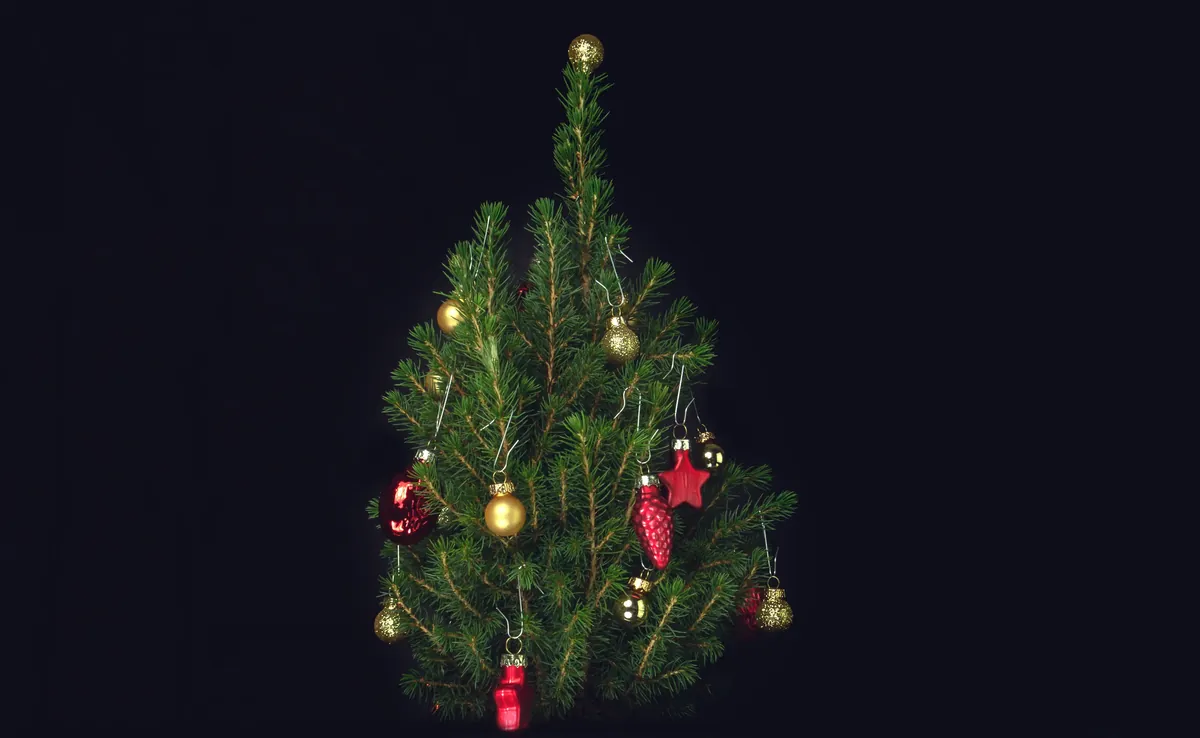
How to do it: Start with a dark green small tree and hang jewel tone Christmas ornaments in red, gold and emerald — three colours, repeated evenly from top to bottom. Add warm lights, tuck in a few gold picks for sparkle, and stand the tree where the evening lamplight can catch it. Check the latest price on Amazon before you buy.
Cost: $30–$65 · Time: 30 minutes
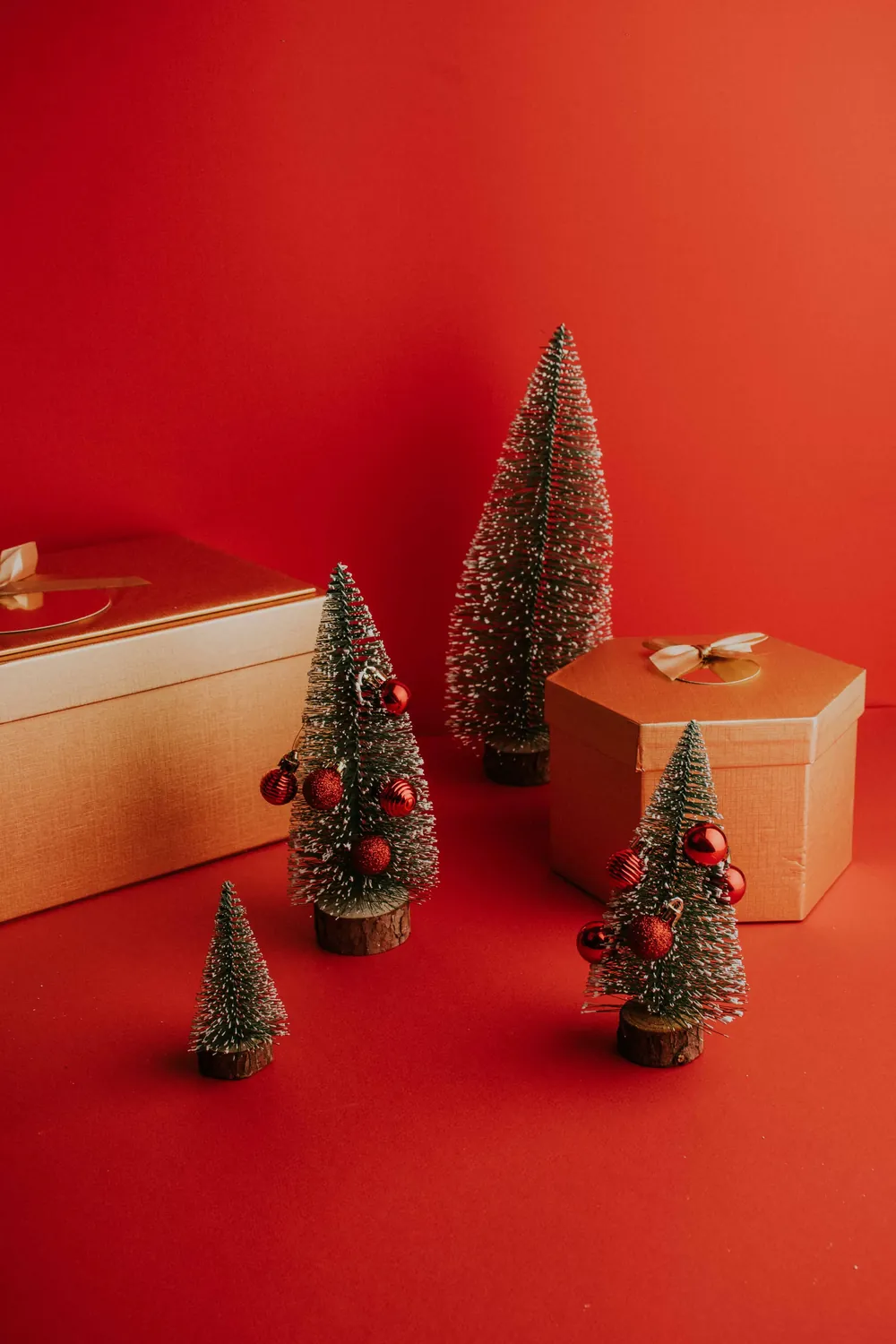
11. The Red-on-Red Mini Tree Trio
Red on red should be too much, and somehow it is exactly right. Three miniature trees with red baubles against a red background look like a Christmas card come to life — bold, joyful and completely unapologetic — and they make the perfect display for a mantel, a shelf or a sideboard where one tree would get lost. I love this idea for anyone who thinks small trees look timid, because a trio of them has more presence than a single tree twice their size. Keep the baubles small and the trees different heights so the group feels like a little forest rather than a row of soldiers.
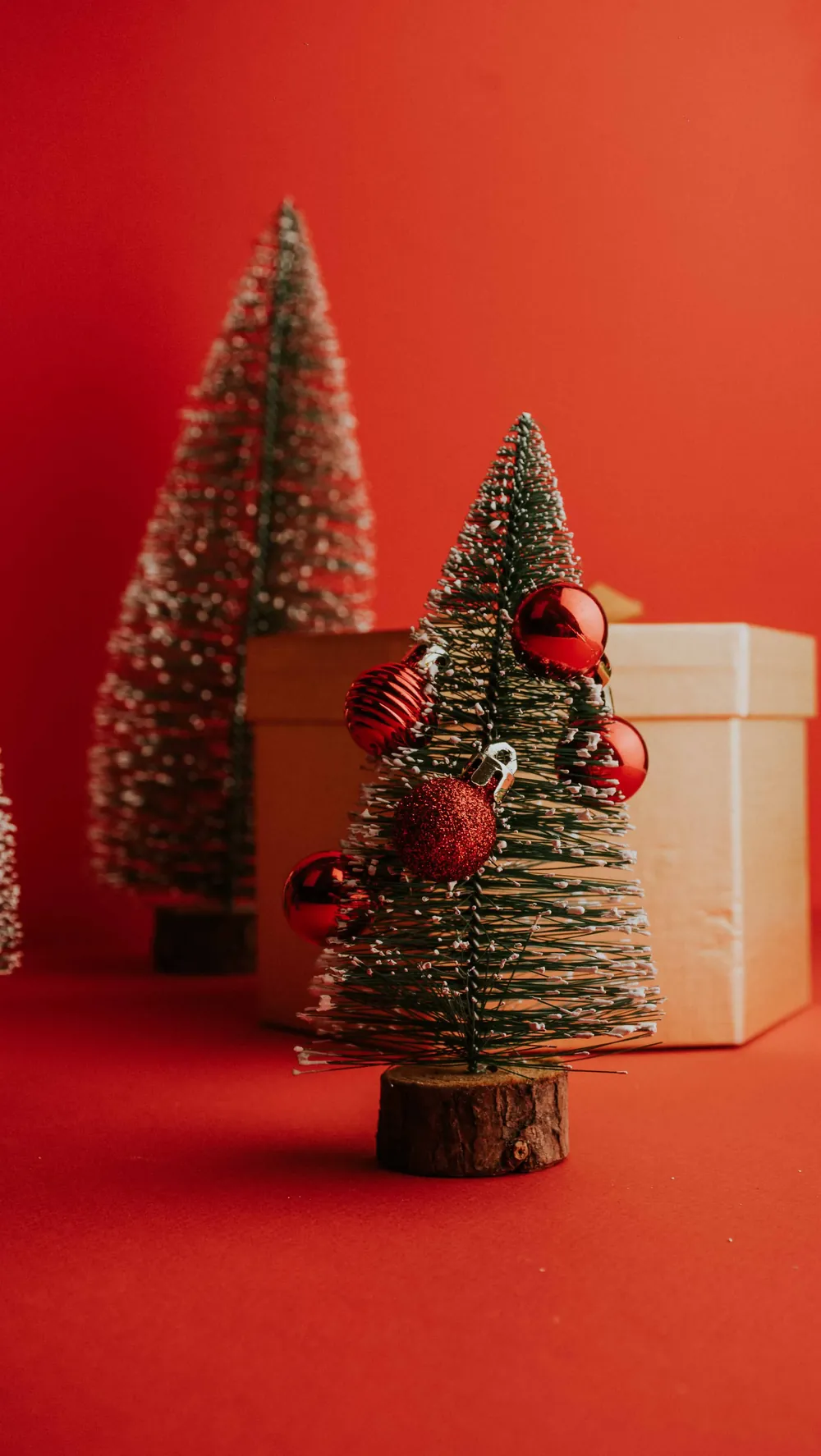
How to do it: Arrange three mini trees of different heights on a shelf or mantel, then hang red Christmas baubles in two sizes on each one. Add a short string of warm lights across the group and a red ribbon around the tallest tree’s pot, and let the bold colour do all the work. Check the latest price on Amazon before you buy.
Cost: $20–$45 · Time: 20 minutes
12. The Santa-Lover’s Tree
Every family has a theme they come back to, and in our house it is Santa. A small tree covered in Santa ornaments — jolly faces, little boots, tiny hats — is pure joy, and it is the tree the children always crowd around first. The trick with a character tree is letting one character own it: Santa ornaments plus red and white baubles plus a few candy canes, and nothing else competing for attention. It looks cheerful rather than chaotic because the palette stays disciplined, and the wrapped gifts underneath carry the red and white right down to the floor. This is the tree for the house that does Christmas with its whole heart.
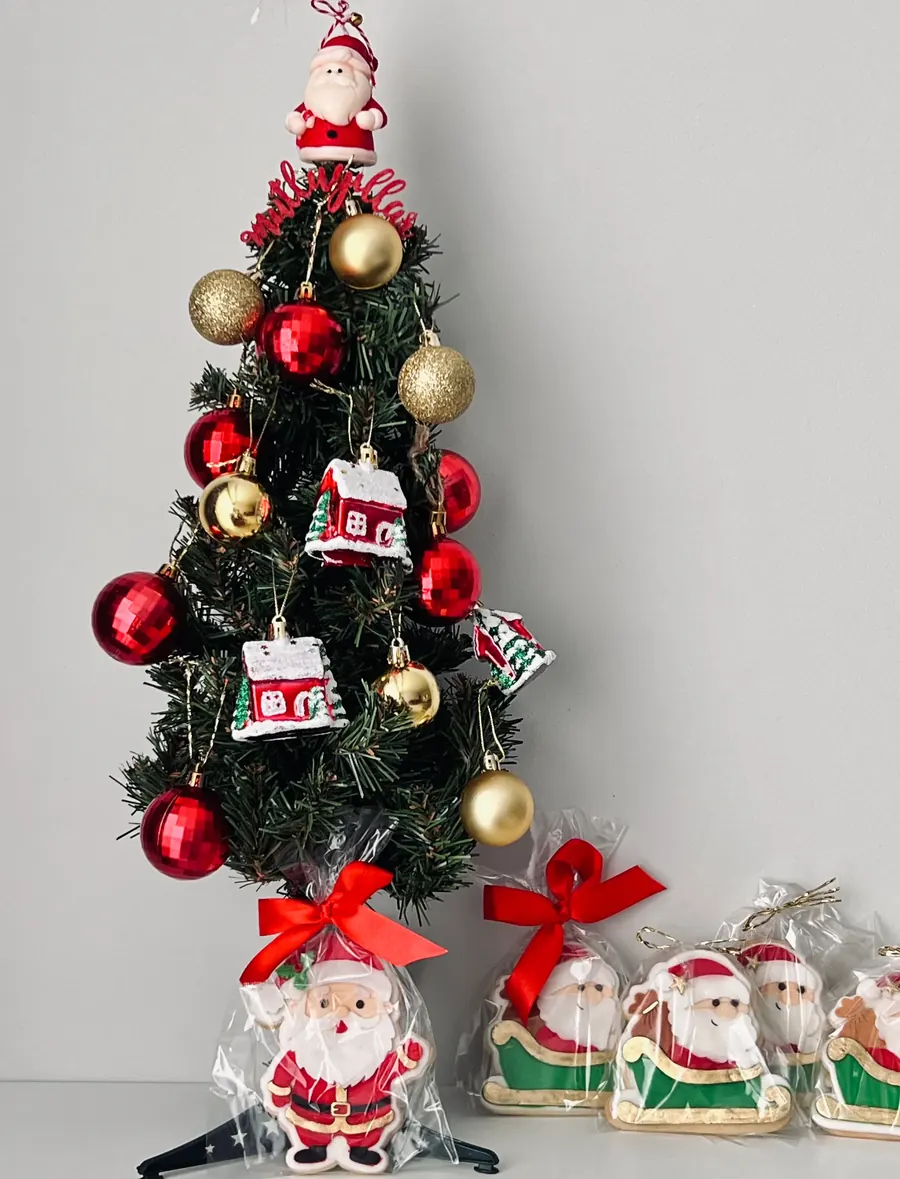
How to do it: Hang a set of Santa Christmas ornaments evenly around a small tree, then fill the gaps with plain red and white baubles so the Santas stand out. Add warm lights, a red star topper, and wrap the gifts in red and white paper to match. Check the latest price on Amazon before you buy.
Cost: $25–$55 · Time: 30 minutes
13. The Colourful-Lights Tree
Warm white lights are lovely, but some years call for colour, and a small tree is the perfect place for it. Multicolour lights on a little tree feel like childhood — bright, cheerful and a little bit magic — and because the tree is small, the colours stay joyful instead of turning into a fairground. I put one in the hallway where it greets everyone coming home, and the rainbow glow on the wall behind it makes the whole entrance feel like a party. The ornaments can stay simple here, because the lights are the decoration; a few plain baubles in white and silver are all you need to let the colours shine.
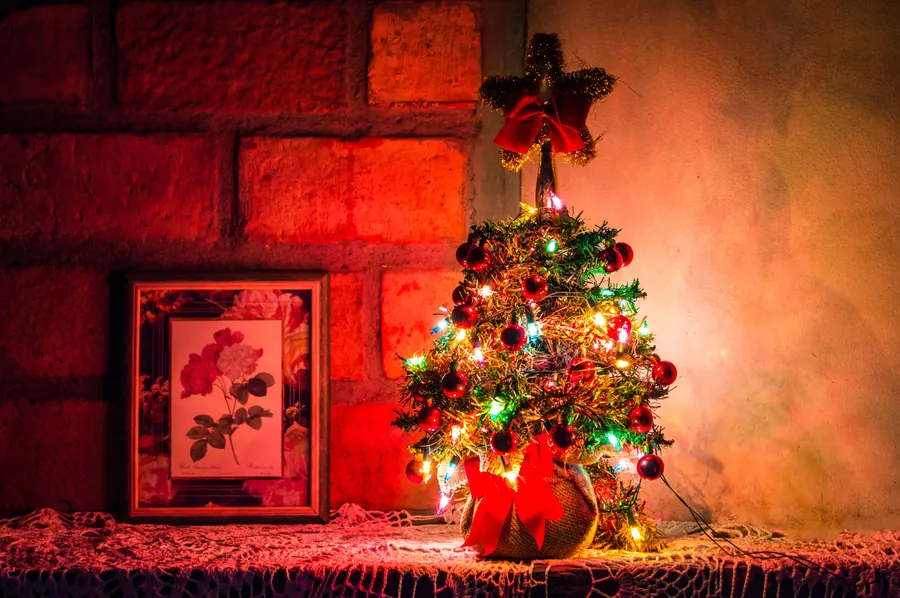
How to do it: Wrap multicolour Christmas tree lights around a small tree, starting at the top and spacing the colours evenly so no single colour clumps together. Hang a few plain white and silver baubles, add a simple star, and place the tree where the coloured glow can fall on a pale wall behind it. Check the latest price on Amazon before you buy.
Cost: $20–$45 · Time: 20 minutes
14. The Gift-Ready Mini Tree
A small tree with gifts already tucked under it feels like Christmas morning has arrived early, and I love that feeling so much I started wrapping a few empty boxes just for the look. The secret is scale: tiny gifts under a tiny tree look intentional and adorable, while full-size presents under a mini tree look like a mistake. I use miniature gift boxes as ornaments too — a few hung from the branches with ribbon — so the whole tree reads as one happy gift theme from top to bottom. Keep the wrapping paper to two colours and the ribbons curled, and the tree will look like it came from a shop window.
How to do it: Hang a few mini Christmas gift boxes from the branches with thin ribbon, then stack real small gifts and wrapped empty boxes around the base. Keep the paper to two colours — red and gold, or red and white — and curl the ribbon ends with scissors for a finished look. Check the latest price on Amazon before you buy.
Cost: $15–$40 · Time: 25 minutes
15. The Pastel Snowman Tree
Pastel Christmas is having a moment, and a small tree is the gentlest way to try it. Soft pink, pale blue and mint baubles with one cheerful snowman ornament make a tree that feels like a snow globe — sweet, light and completely different from the red-and-green downstairs. I love this one for a bedroom or a child’s room, where the softer colours feel calm at bedtime and magical in the morning light. The snowman is the key: one character ornament gives the whole pastel palette a focal point, so the tree reads as charming rather than washed out. Keep the lights warm white, because cool white would freeze the pastels.
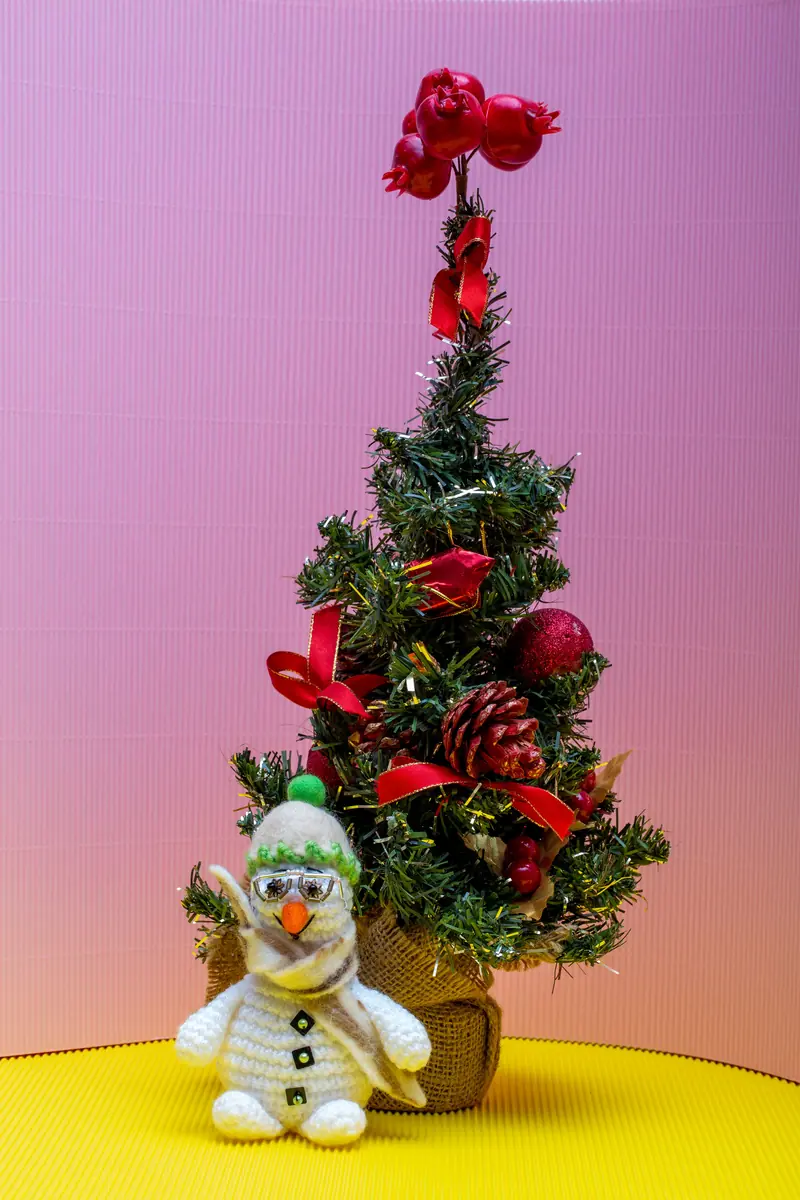
How to do it: Hang pastel Christmas ornaments in pink, pale blue and mint on a small white or green tree, then place one snowman ornament at eye level as the star of the show. Add warm white fairy lights, a white star topper, and a soft blanket folded at the base instead of a tree skirt. Check the latest price on Amazon before you buy.
Cost: $20–$50 · Time: 20 minutes
16. The Burlap-Wrapped Potted Tree
There is something honest and lovely about a potted tree wrapped in burlap with a red ribbon — it looks like it came from a Christmas tree farm rather than a shop, and it brings the outdoors inside. I use potted trees on the porch and in the hallway, where the burlap hides the plastic pot and the ribbon gives it a finished, gift-like feel. Best of all, a potted tree can go back outside after Christmas, or live on in a bigger pot on the balcony — the most sustainable tree on this list. Keep the ornaments simple — a few red baubles and a ribbon — and let the burlap be the texture.
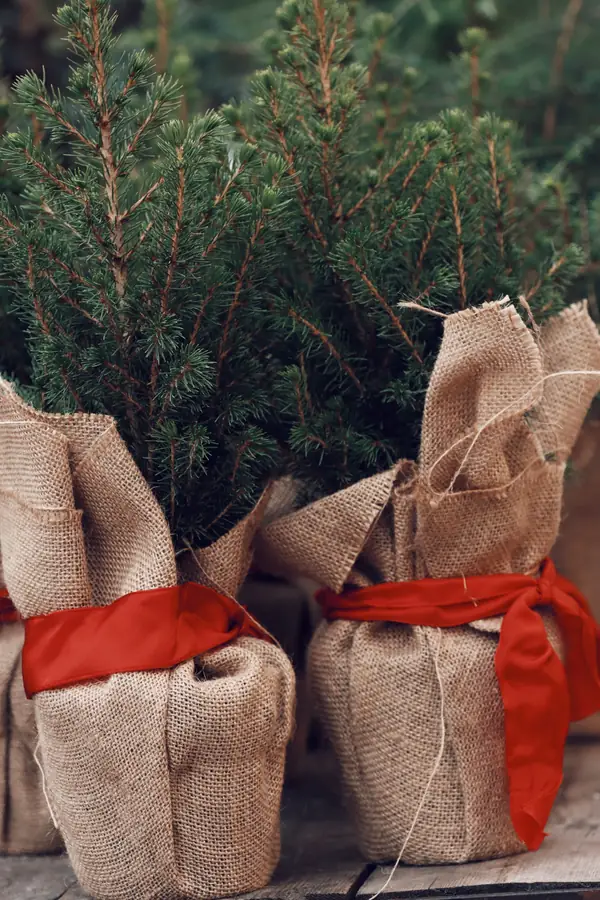
How to do it: Wrap the pot of a small potted tree in a small burlap tree skirt or a square of burlap fabric, tie it with a wide red ribbon, and hang a few red baubles on the branches. Add a short string of warm lights, water the tree if it is live, and place it by the door where everyone can see it. Check the latest price on Amazon before you buy.
Cost: $20–$55 · Time: 15 minutes
17. The Plaid Star Topper Tree
Plaid is the pattern of a cozy Christmas, and a plaid star topper is the fastest way to give a small tree a whole personality. I found mine at a craft fair years ago — red and black buffalo check, slightly wonky, completely perfect — and it has topped every small tree since. The trick is repeating the plaid once more somewhere on the tree, a ribbon or two, so the topper does not look lonely, and keeping the baubles to red, cream and wood so the pattern has room to breathe. This is the tree for the farmhouse lover, the cabin dreamer, and anyone whose Christmas smells faintly of cinnamon and woodsmoke.
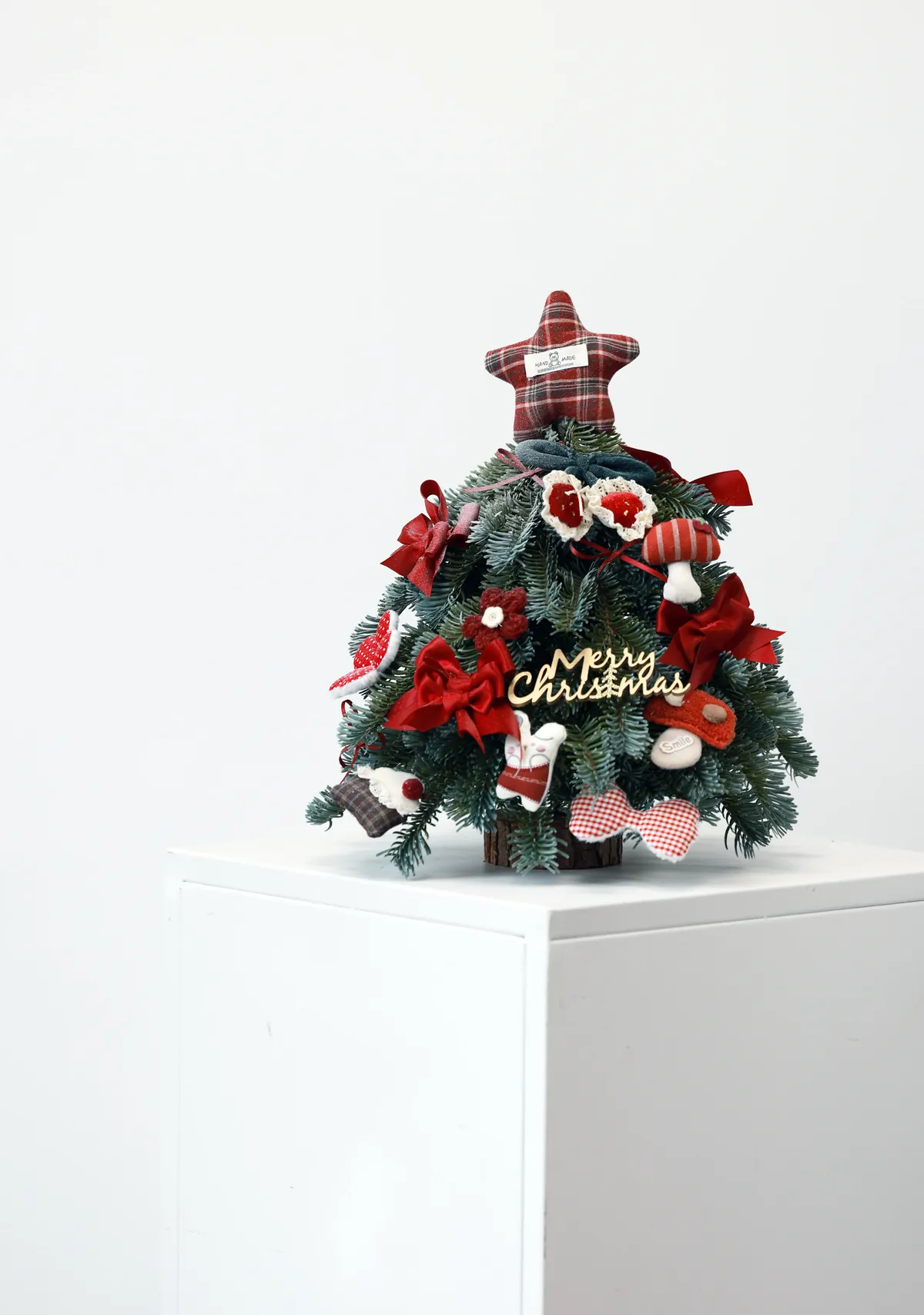
How to do it: Top the tree with a plaid Christmas tree topper star, then weave a length of matching plaid ribbon down the branches in a loose spiral. Hang red and cream baubles with a few wooden ornaments, add warm lights, and finish with a plaid ribbon tied around the pot. Check the latest price on Amazon before you buy.
Cost: $25–$55 · Time: 25 minutes
18. The Family-Room Tree
This is the tree that does the most work in the house: the family-room tree that holds the presents, anchors the sofa corner, and somehow makes the whole room feel like Christmas even before the stockings go up. Ours is a slim four-footer, and it works because everything about it is proportional — small baubles, a short light string, and gifts stacked neatly rather than sprawled. I decorate it in one sitting on the first weekend of December, and then it just quietly glows in the background of every evening for a month. The presents underneath are half the decoration, so I wrap them early.
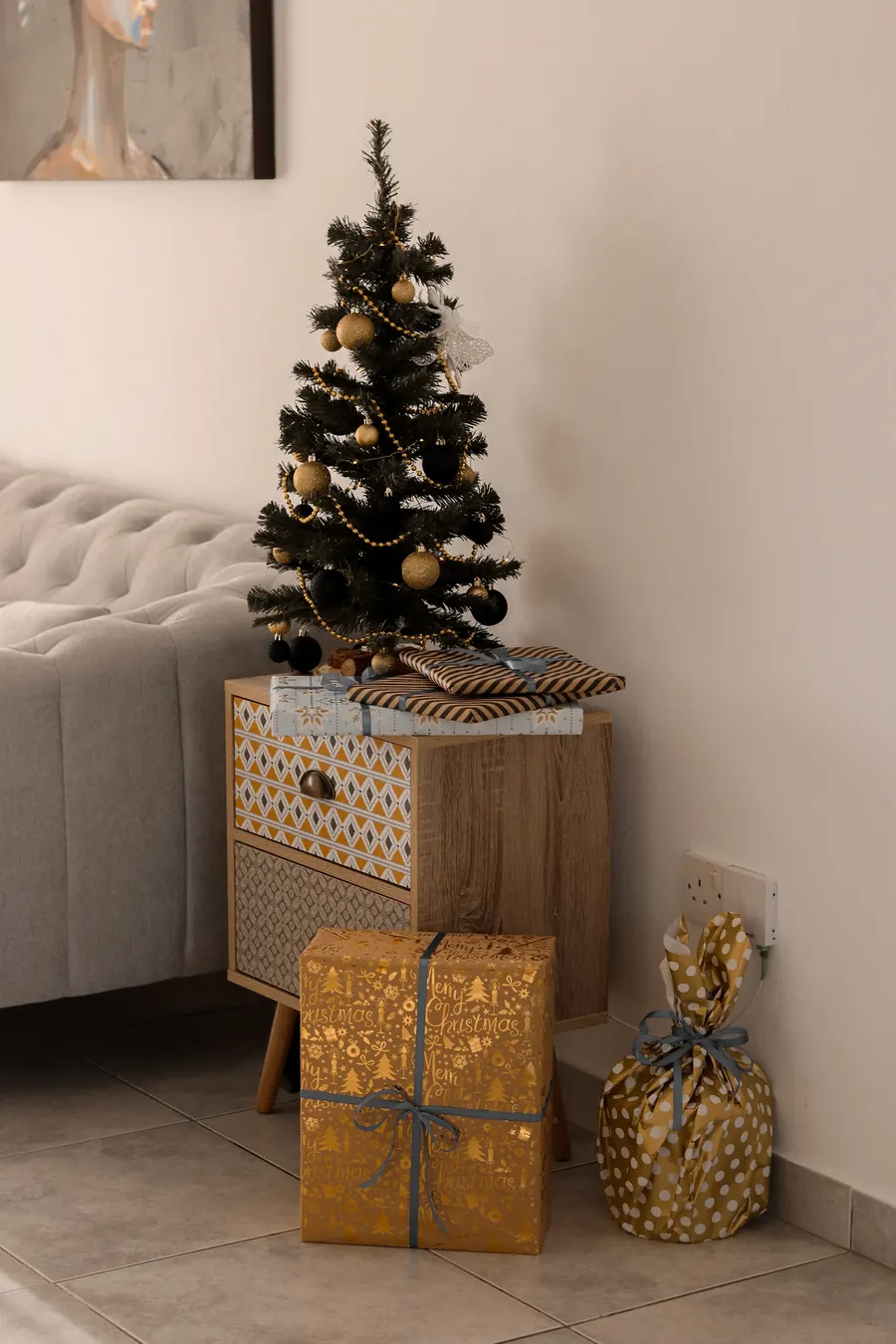
How to do it: Set a slim small tree in the family-room corner and dress it with warm lights and baubles in your family’s colours, then lay a small Christmas tree skirt under it to catch the needles and hide the stand. Stack the wrapped gifts around the skirt in two heights — tall boxes at the back, small ones at the front — and add the star last. Check the latest price on Amazon before you buy.
Cost: $35–$85 · Time: 40 minutes
19. The Kitchen Counter Tree
The kitchen is where everyone gathers in December, and it deserves its own little tree. Mine lives on the counter next to the kettle — a small tree wrapped in brown paper with fairy lights, close enough to the baking and the tea-making that it feels part of the cooking rather than part of the decorating. The brown paper is the genius of it: it looks like a parcel, it matches the kraft gift wrap, and it costs almost nothing. I keep the ornaments to a minimum — a few small baubles and a star — because a kitchen tree has to survive steam, flour and curious hands, and simple is sturdier than fussy.
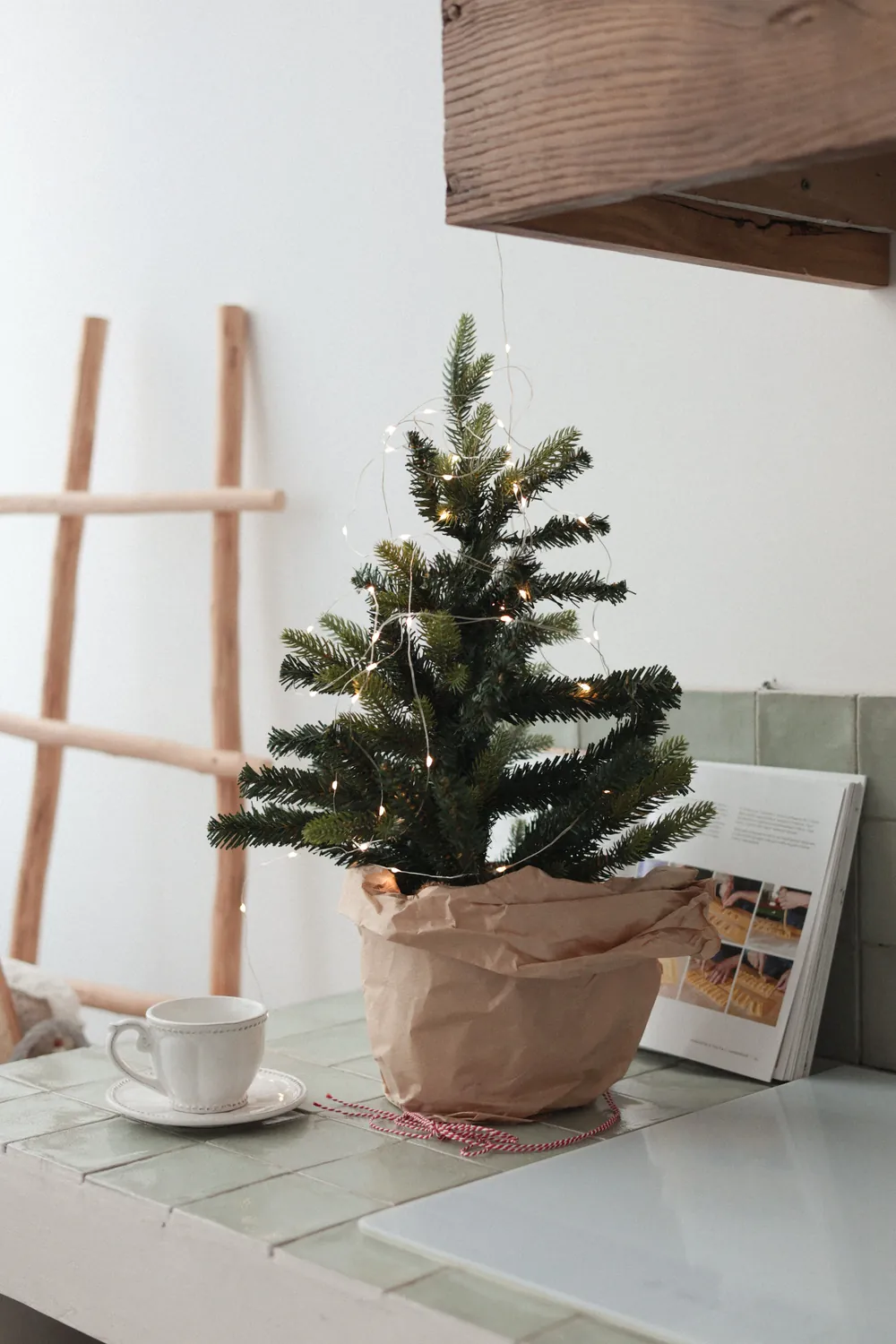
How to do it: Wrap the pot of a potted mini Christmas tree in brown kraft paper, tie it with twine, and set it on the kitchen counter away from the hob. Add warm fairy lights and a handful of small baubles, then tuck a cinnamon stick or two into the branches for scent. Check the latest price on Amazon before you buy.
Cost: $15–$40 · Time: 15 minutes
20. The Wooden-Table Mini Tree Cluster
Sometimes one small tree is not the answer — three tiny ones are. A cluster of miniature trees on a wooden table has more charm than any single tree I own, because the different heights create a little forest and the wood underneath warms the whole scene. I keep this one on the dining table as a centrepiece through December, and it doubles as the place where the advent treats live — a tiny gift tucked behind each tree, found one by one. The trees themselves need almost nothing: a few baubles each, one short light string across the group, and the wooden table doing the rest.
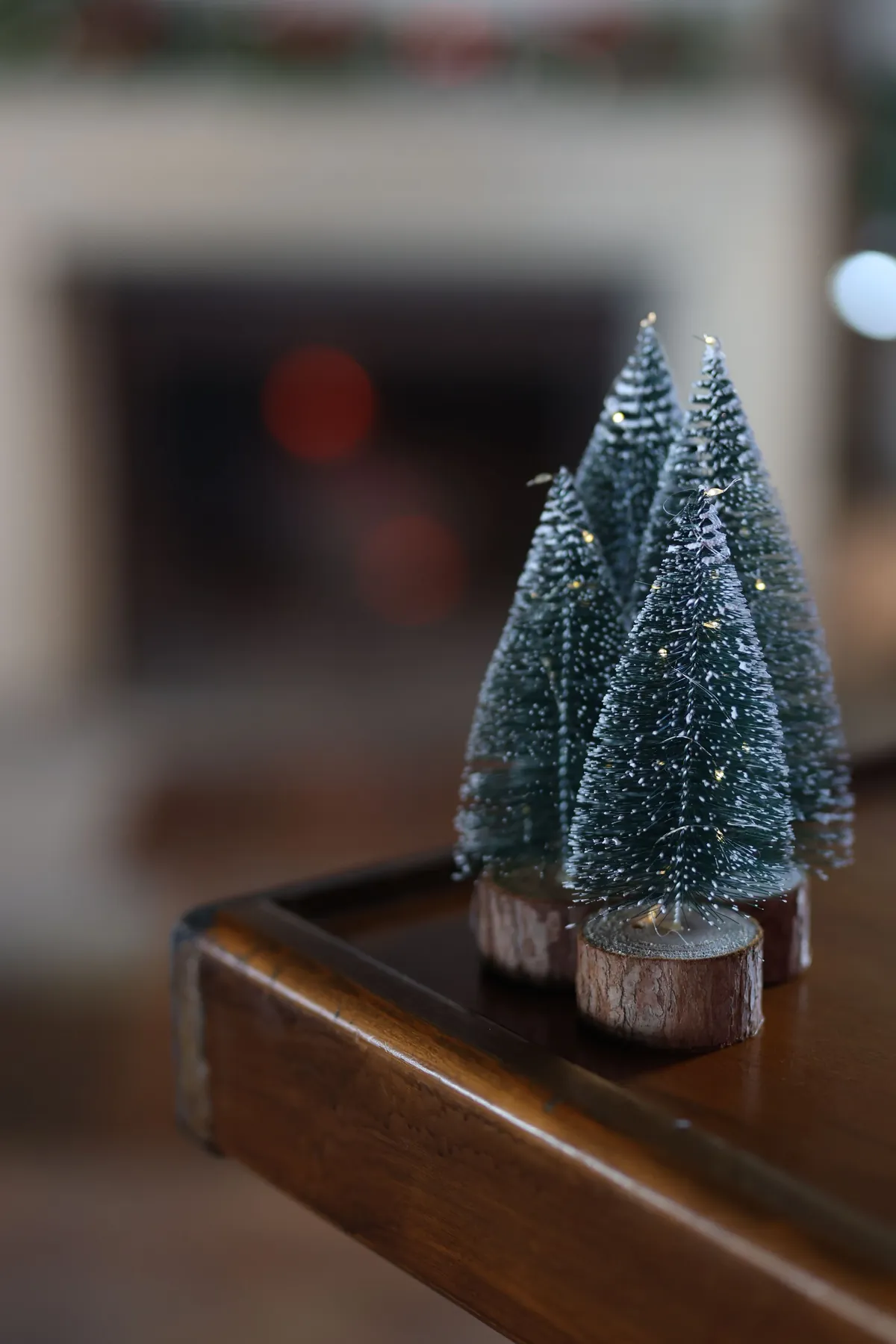
How to do it: Group a set of bottle brush Christmas trees in three heights on a wooden table or tray, then hang two or three tiny baubles on each one. Weave one short string of fairy lights through the group, scatter a few pinecones between the trees, and tuck a tiny wrapped gift behind each tree. Check the latest price on Amazon before you buy.
Cost: $15–$35 · Time: 15 minutes
21. The Outdoor Potted Tree
A small tree does not have to live indoors, and the one by my front door is proof. A potted tree with colourful ornaments and ribbons stands on the porch all December, greeting everyone who arrives, and because it is in a pot it goes straight back to the garden in January to grow a little bigger for next year. The secret to an outdoor small tree is weight: a heavy pot, or a pot wedged into a basket, so the winter wind cannot topple it, and shatterproof ornaments so a gust does not become a disaster. It is the most welcoming tree on this list, and it costs less than a wreath.
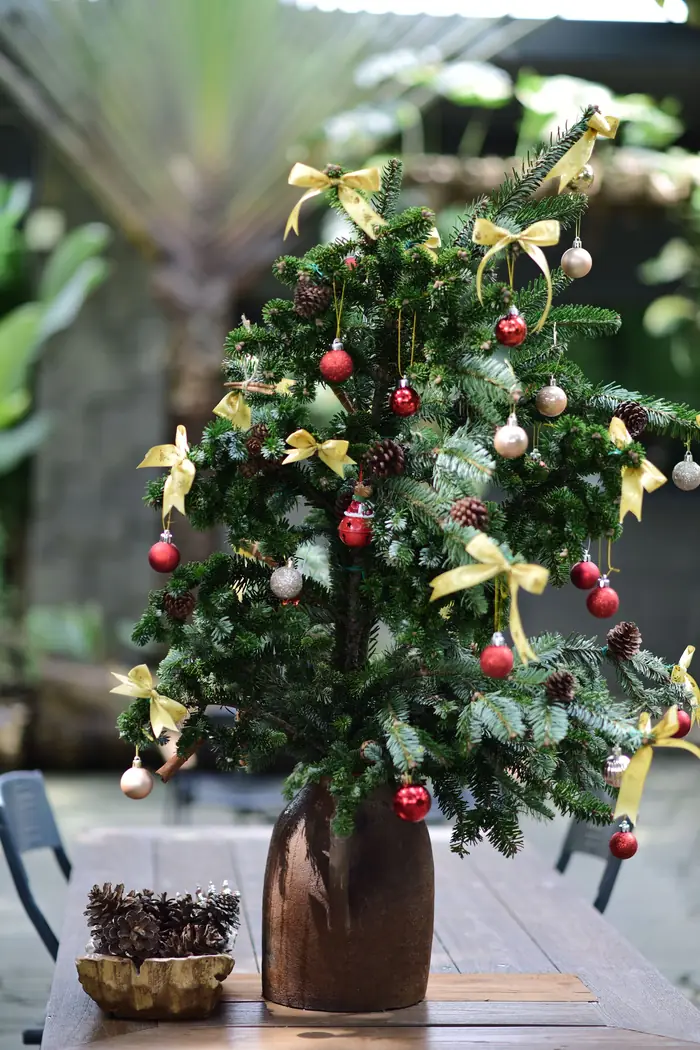
How to do it: Set a small potted tree in a heavy terracotta plant pot by the front door, then hang shatterproof baubles in bright colours and tie ribbons to the branch tips. Add outdoor fairy lights on a timer, and check the pot after heavy rain so the tree never sits in standing water. Check the latest price on Amazon before you buy.
Cost: $25–$60 · Time: 20 minutes
22. The Paper and Fabric Tree Trio
Some of my favourite Christmas trees are not trees at all — paper and fabric, folded into little cones that sit on a shelf and make me smile every time I pass. This is for the crafter, the renter who cannot have a real tree, or anyone who wants Christmas on a budget so small it barely exists. Paper trees cost pennies, they fold flat for storage, and children can make them in an afternoon with scissors and glue. I display mine on the windowsill with fairy lights behind them, and guests always ask where I bought them — that I made them in an evening is half the pleasure.
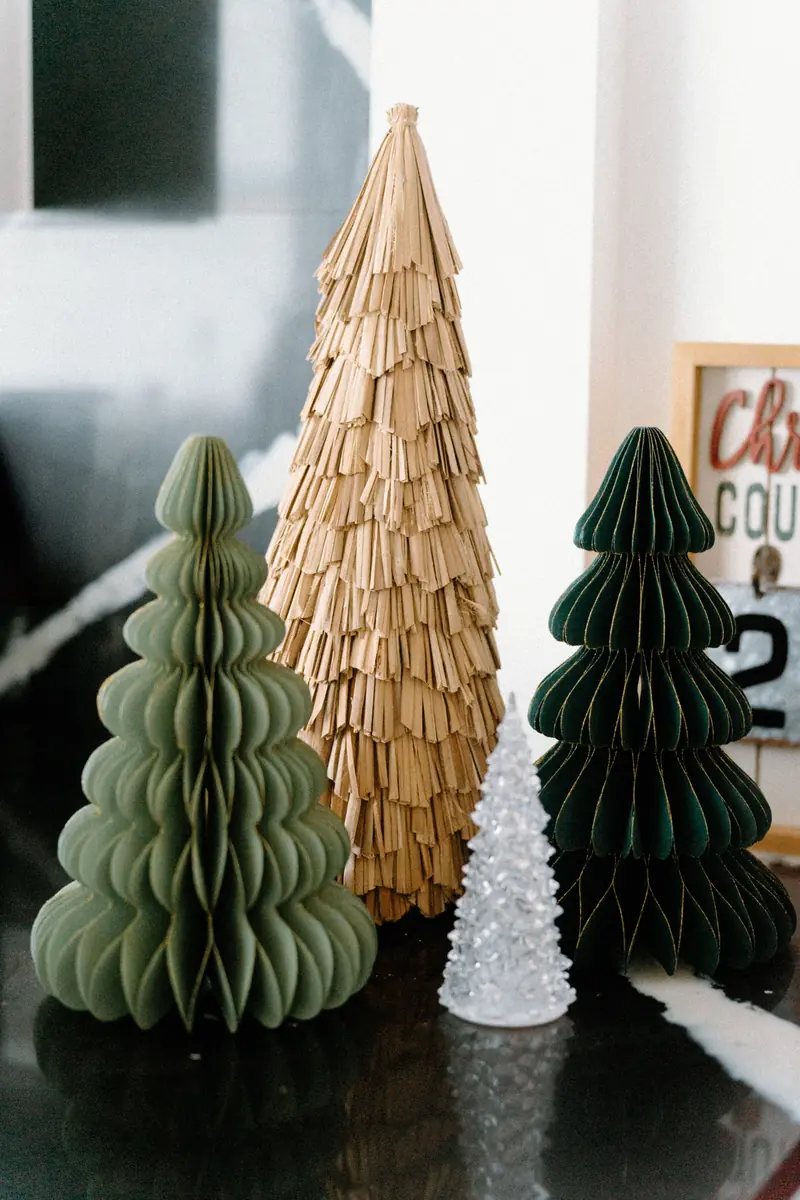
How to do it: Buy a paper Christmas tree decorations DIY kit or fold your own from card and fabric scraps — cones in three heights look best together. Stand them on a shelf or windowsill, tuck a short string of fairy lights behind them, and add a tiny paper star on the tallest one. Check the latest price on Amazon before you buy.
Cost: $5–$20 · Time: 1 hour of happy crafting
23. The Dried-Orange and Cinnamon Mini Trees
If you want a small tree that smells as good as it looks, this is the one. Mini trees dressed with dried orange slices, cinnamon sticks and red baubles bring a natural, old-fashioned Christmas into the house — no glitter, no plastic, just warm colours and the scent of spice every time you walk past. I make the dried oranges in the oven on a quiet Sunday in late November, and the whole house smells like Christmas for hours, which is a gift in itself. This is my favourite tree for the kitchen or the hallway, where the scent can greet people, and it is the one guests always lean in to smell.
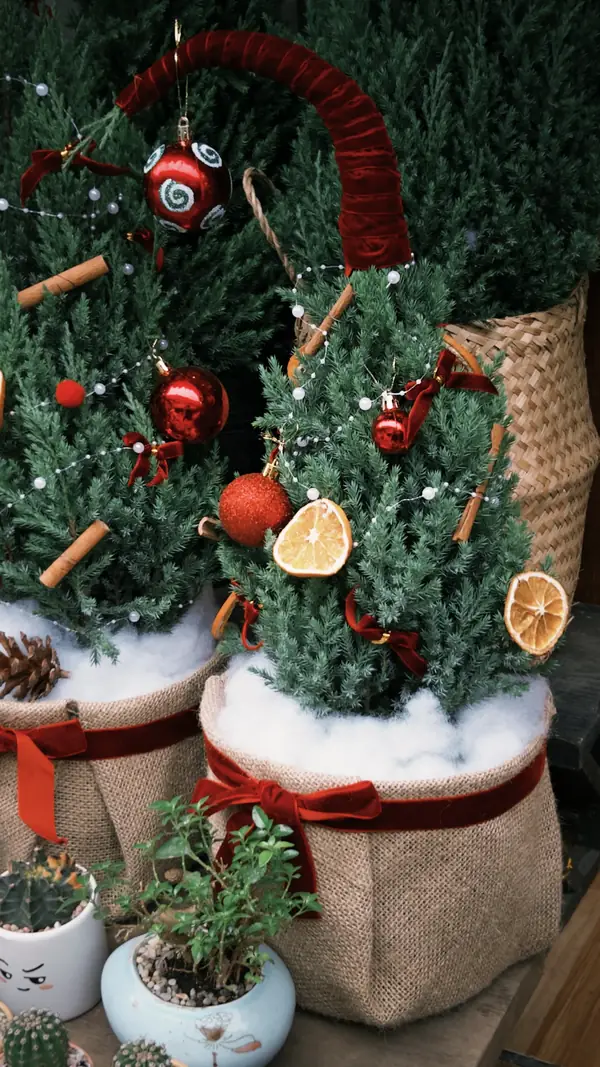
How to do it: Hang a dried orange slices Christmas garland or your own oven-dried slices on mini trees with twine, then tie cinnamon sticks in small bundles with ribbon and hang them between the baubles. Add red baubles and warm lights, and keep the trees away from steam so the oranges stay crisp. Check the latest price on Amazon before you buy.
Cost: $10–$30 · Time: 45 minutes including drying
The 15-Minute Tabletop Tree
If you only have fifteen minutes before guests arrive, do this: set the tree on the table, plug in the fairy lights, hang the baubles, put the star on top. In that order, and do not stop to rearrange. A small tree with lights, baubles and a star looks finished even if nothing else is on it — because those three things are the whole language of a Christmas tree. Everything else on this list is a variation on those three. So if you are short on time, do the three, pour yourself a drink, and enjoy the glow.
Copy the Look: My Small Tree Formula
After years of decorating small trees, I have a formula that works every single time, whatever your style. One tree at eye level — on a table, a cabinet or a sill, never lost on the floor. One string of lights, warm white unless the room asks for colour. Three bauble colours at most, each repeated three times. One topper that means something to you — a star, a bow, a paper angel. And one thing at the base — gifts, a skirt, a basket — to hide the stand and ground the tree. Eye level, lights, three colours, one topper, one base. Follow that and your small tree will look considered, whatever you put on it.
Buy-Once List: The Small Tree Kit That Lasts for Years
These are the pieces I buy once and use every single December. Buy them well and they will last a decade:
- A 4 ft slim artificial tree — the main tree for small living rooms
- Battery fairy lights in warm white — one string per tree, no trailing wires
- Shatterproof ornaments — safe with children and pets, and they never break
- A small tree skirt — hides the stand and catches the needles
- Mini ornaments in your colours — small baubles for small branches
- A gold star topper — the finishing touch on every tree on this list
If you would like a little help planning it all, my Christmas Home Decor Planner has a page for every room — including a small-tree checklist — so you can plan the whole house in one calm afternoon instead of trying to remember it all in your head.
☐ Your Small Christmas Tree Checklist
Print this list and tick each one off as you go — the whole little tree, in one afternoon:
☐ Measure your spot: table, sill, cabinet or corner — and the height above it
☐ Pick your tree size: tabletop, 3 ft, or a slim 4 ft for the corner
☐ Choose your palette: three colours at most, each repeated three times
☐ Buy or find a heavy pot or stand so the tree cannot tip
☐ Wrap the lights first, from the top down, then plug them in to check
☐ Hang the biggest baubles first, then fill the gaps with small ones
☐ Add the topper last — star, bow or paper angel
☐ Hide the base with a skirt, a basket, burlap or brown paper
☐ Stack the wrapped gifts around the base, tall at the back
☐ Add the scent: dried orange, cinnamon sticks or a pine sprig
☐ Set the lights on a timer so they switch off at bedtime
☐ Step back and check the tree from the sofa, not just up close
☐ Tuck the spare baubles away for next year before they scatter
☐ Water a live potted tree, and keep it out of standing water
☐ Stand at the door, look at your little tree, and enjoy it
Frequently Asked Questions
What size tree counts as a small Christmas tree?
Anything under 5 feet is a small tree in most homes — tabletop trees are usually 1 to 2 feet, and slim 3 to 4 foot trees are the sweet spot for small living rooms. The right size is the one that fits your spot with at least a foot of clear space above it, so the star never brushes the ceiling or the shelf.
How many ornaments do I need for a small tree?
Far fewer than you think. A 2 foot tabletop tree looks full with 10 to 15 small baubles, and a 4 foot slim tree needs about 25 to 30. Small baubles are the key — full-size ornaments overwhelm small branches, so buy the mini sets and let the tree’s shape show through.
Can I put a small Christmas tree on a windowsill?
Yes, if the sill is wider than the tree’s base and the pot is heavy enough that the tree cannot tip. Use battery fairy lights so no wire trails across the window, and keep the tree away from radiators and curtains. A windowsill tree glows beautifully from the street after dark.
Is a real potted tree better than an artificial small tree?
Both work, and it depends on your plans. A live potted tree smells wonderful and can go back outside in January, but it needs watering and a cool spot away from radiators. An artificial tree costs less over the years, needs no care, and folds away flat. If you love the scent, go live; if you love easy, go artificial.
When should I put up a small Christmas tree?
The first weekend of December is the sweet spot — early enough to enjoy it all month, and late enough that the excitement lasts until Christmas. A small tree takes under an hour to decorate, so you can put it up in one calm evening and add the gifts underneath over the following week.
Your small tree is proof that Christmas does not need a big house or a big budget — just a little tree, a string of lights and an evening to enjoy putting it up. Pick one idea from this list tonight — the tabletop tree takes twenty minutes — and let the rest of the house catch up over the week. And if the bedroom still needs its Christmas layers, my 29 cozy Christmas bedroom ideas will carry the same warm feeling from the tree to the bed. Happy decorating, and merry Christmas.
One Comment